
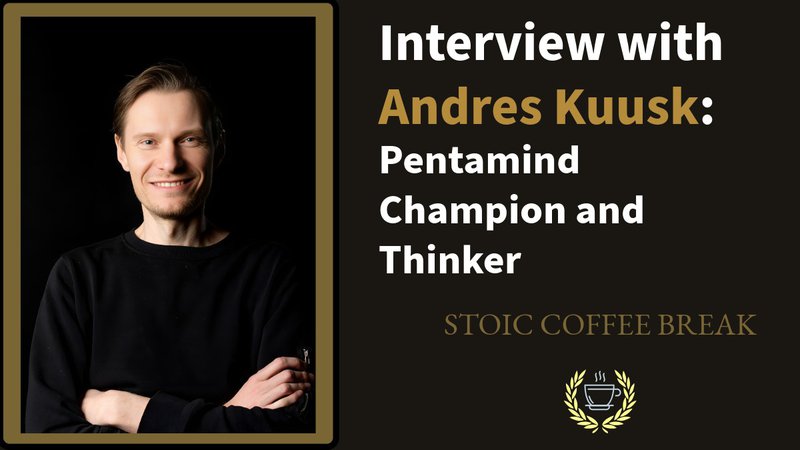
Andres Kuusk is a seven-time World Pentamind Champion, former Game Theory lecturer, economist and C-suite executive, he has spent more than two decades identifying the hidden thinking errors that separate successful people from equally talented people who never reach their potential.
His work combines behavioral science, strategic thinking and real-world decision-making into practical frameworks leaders can immediately apply.
Transcript:
Erick: Hello, friends. My name is Erick Cloward, and welcome to the Stoic Coffee Break. In this week's episode, we're going to be talking with Andres Kuusk. And Andres is a seven-time World Pentamind Champion, former game theory lecturer and economist, a C-suite executive, and has spent more than two decades identifying hidden thinking errors that separate successful people from equally talented people who never reach their potential.
His work combines behavioral science, strategic thinking, and real-world decisions into a practical framework that leaders can apply immediately in their work. So the World Pentamind Championship, which I'd never heard of that before this, is a widely re-rec- regarded as the world's championship of all-around mind sports, combining games that require different forms of strategic thinking rather than just mastery of a single discipline.
So he is also the author of Unlocking the Success Puzzle, which talks... takes his research over two decades and real-world experience and puts them into 10 practical rules for improving judgment, decisions, and long-term results. So Andres, welcome to the show
Andres Kuusk: Thank you. It's great to be here
Erick: Yeah, so Andres is joining us from Estonia, and if you don't know where that is, then you should go get your map. It's a small country up on the Baltics, and, uncomfortably close to Russia, I would say, unfortunately. But hopefully, hopefully that won't turn into an issue in the future, but we'll see. So Andres contacted me a little bit ago, and I found it interesting because usually the, the people I have on this podcast are heavily into stoicism, but one of the things that I really like to try on this podcast is to get people who, who really think about thinking, because that's a big part of what stoicism is, is that rather than it just being a reactive person in your life, of following your emotions and your feelings, that you actually take time to think about what's going on in your mind and actually do something about that.
So in starting out why don't you tell us a little bit more about yourself and how you got interested in Pentamind and what's, what path that, that led you down into kind of thinking about thinking and, and the success you've had in your life?
Andres Kuusk: Okay, I'm starting with with a brief summary of of my career. I think I have had a rather unusual I have worked in very different worlds. I have been professional mind sports player, I have been, lecturing in a university, I also have been a C-suite executive in a in, in a fintech company. And now very recently, I'm also a half-time, author or write-writer. So I really have touched very different disciplines. but but I can also say that even though they very different from the outside, there are definitely, those kind of touching points that unite them and and one of them is decision-making under uncertainty. and obviously understanding your own thinking and being able to improve your thinking is big part of it being successful all those fields. Now, how did I got into the Pentamind? I have been playing mind sports from very early childhood. I started out with chess when I was six or seven years old. then one after another I added more games. And at some moment, I was good enough in, in, in several, one se-several of them. So I thought why not to give it a try to compete in Pentamind, which is basically mind sports combined. It combines very different mind sports together. So for somebody like me who was not playing only one of them but several ones this sound like-- sounded like a, a logical, step And once I got into it, I fell in love, and and then I just couldn't stop. And I played professionally for many years. And even nowadays, when I'm time not not professional anymore, but I'm still very much dedicated in it and taking it still very seriously. I sometimes call myself, not a professional, but a semi-professional, meaning that I'm not earning money with it, so that, that part is missing, but I'm still spending as much time as some professionals do.
So that's that's how I call it myself, like semi-professional.
Erick: And so from doing these different mind games and stuff like that, that got you interested into decision-making and I guess metacognition and other areas like that?
Andres Kuusk: Yes, exactly. I would say that one reason why I really deeply got into observing your own thinking or thinking about your thinking is because I observed many people, many capable and intelligent people failing their their goals or failing their potential. not in not only in one domain, but in, in all of those domains that I have working in. And I was fascinated why? Why is this happening? Why is it happening every- everywhere? And and and the same was actually true with myself as well in my early career. I wasn't really successful. So I think this interest really started from there, from being unhappy with my own performance and and wanting to And and also another important thing is that after having touched so many different worlds, I realized that let's say sound strategic thinking or and strategic decision-making, they are not really, unique in, in every disciplines but rather they the, the same principles, transfer across domains.
So that was another kind of interesting finding that kind of got me getting more, even more interesting-- interested in those topics
Erick: So why would you say that intelligent people repeatedly make poor mistakes even despite having tons of experience or expertise in one certain area? What is it that keeps them, you know, keeps them from a- accelerating and becoming successful?
Andres Kuusk: One reason that I have recently studied really a lot is that we make thinking errors or or cognitive distortions which are silently without us even knowing they are influencing our thinking and and not always positively. quite often they are influencing our thinking in a way that they us making decisions that actually sabotage our own goals. And that's the reason that I have been the most interested in that that, intelligence is not enough. We are not really controlling those those instincts that are working subconsciously and and are sabotaging our decisions.
Erick: So which cognitive distortions are the most common that undermine people, and how can we get better about avoiding those?
Andres Kuusk: I would say one of the most common ones happens when we start with something new. We, let's say, start some new skill, whatever it is, learning to play a or p-piano or tennis or whatever, trying to make a ca-career change and and studying data science or whatever it is. e-- when we get started and the beginning is difficult, we very often come to the idea that this is not for us. Our shape is not meant for it. We are talented for something else, but we are definitely not talented for s-for this specific thing. And those people who are in this specific domain, they have this talent that we do not have. So this is very common conclusion that we come up with in our head. And sometimes there can be some truth in it but but a lo-a lot of times it is just plain wrong because most of the times beginning is difficult. When you learn some new difficult skills, beginning is always difficult, and it is difficult for everybody. And and the difference between people who quit early because they think they, they are not talented enough and people who eventually succeed is not that some people have talent and some people have-- don't have.
The difference is that some people do not of early difficulty as a signal to stop, and so they continue in the process and and after some time they start seeing progress. And and if they already start seeing progress, then motivation increases, they continue, and eventually they succeed. So in my opinion this is by far more important reason for, for differentiating who, who succeeds and who who fails rather than some natural talent. So believing that you lack talent is much more much more harmful than actually lacking talent
Erick: Okay, so basically persistence beats m- you know, is, is more important than individual talent
Andres Kuusk: Yes, I'm not even sure I would call it persistence but in some sense, yes, you have to persist through those early, early difficult times, and you have to really realize that those times are not difficult only for you. If you look at somebody who is now successful you have to realize that if they were were at the same place in their learning curve where you are right now, they struggled the exact same way. And then basically this belief that you lack talent, that you can-- and you cannot succeed anyways, this this belief goes out of the window. But but as long as you believe that you are not talented and you cannot succeed anyways, you won't succeed anyways because the, you lose motivation because obviously you don't want to put in a lot of effort if you think that you anyways cannot succeed. And and therefore you decrease effort. Eventually you stop at all and then it feels that your belief, is proven to be correct, that you didn't have the talent. But but but this belief is self-fulfilling. If you bel-believe you don't have talent, then your motivation decreases, then you put in less effort, then you stop and you don't reach your goal, and and you can think that actually you were correct all the time, that you didn't have enough talent, and that's why you didn't succeed.
But in fact, the reason was something entirely different.
Erick: Yeah. It's, i- it's interesting because I think for me it reminds me of there was this great quote by Ira Glass, and I'm just gonna paraphrase it here, where he talked about how sometimes when you're starting, like, a creative endeavor, your ta- your tasting is really good. Like, you know what's good, but the work that you're putting out just isn't, isn't, isn't very good, and you, you compare it to what is really good because that's where your taste is.
You know what, what's, you know, like if you know what good music is, and then you sit down and you try and write good music, and it just isn't that good. And so he talked about for him and for plenty of his friends, he noticed that really came down to not comparing what's, what your best is, you know, what's, what the taste is for your best, for the best of whatever that is.
But rather that, you know, you take it for what it is, and you just keep improving on it, and sometimes it takes a while until you kind of reach where the level of your taste and the level of your talent actually meet up
Andres Kuusk: Yes, I think it's a very good point that we compare ourselves with what we observe. And usually when we com-compare ourselves with other people, some musicians, we, we see them only when they are already on top of their game. We don't we don't observe their struggle, how they g- how they got there.
And that's why it seems to us that they might be, hugely talented, but we really haven't haven't seen how, how long time it took them and how much effort it took them. So we compare our difficult beginning to other people's, almost end of the learning curve.
So it's it is definitely unfair comparison.
Erick: Exactly. Yeah, it's kind of like if you, if you want to start a tech company and you go, and you compare it to where Steve Jobs was, you know, obviously, you know, you're gonna be in a very different place. But if you look at where Steve Jobs started out, I mean, he was basically, you know, crashing on couches at his friend's in college and, you know, walking, you know, just taking classes without paying for them, and then, you know, walking across town to get a free dinner on Saturday night because he didn't have any money.
You know? I mean, he started out in incredibly humbled circumstances and then, you know, found ways to make things work, and it was that, that dogged persistence that really got him there
Andres Kuusk: Yes. Yes. We shouldn't forget that every master was once a beginner. We cannot have illusions that somebody was already born a master. Everybody started from
Erick: Yeah. So what are some other cognitive distortions that you notice that keep people from reaching their potential?
Andres Kuusk: One really interesting one is that we tend to be much more objective when we evaluate someone else's life or situation compared to our own. I can give you actually amusing true story. Once, once I made a test with 20 friends of mine. I gave them, each of them a piece of paper and asked them to write most let's say the biggest problem that they have in their lives what they can realistically change so 20 people, there were different answers.
Most most frequent was, was bad boss. I think it got seven votes, and then five votes was money problems and and toxic relationship or some relationship issues. So f- those, those three they were the main the most common answers. But the point was that it has to be something that you can realistically change. So the s- the second question now was are you planning to make a first step the next three months to change it? and the point was not to completely, reverse it or fix it, but just to make a, just to make the first step. For example, if you are unhappy with your job, maybe you look around in in, in a, in job market or change your status in LinkedIn or something like this. most people from from the from those 20, most said no, that that during the next three months, they are not planning to do anything about it. And then as the final question I asked them imagine that the exact s- same situation that you described in the first question, imagine that your best friend has exactly the same issue, now whether would you think that they should make a first move during the next three months? all 20 said yes. So this very clearly shows that we are very much more objective when evaluating some- someone else's situation. But as soon as this is our own situation, then we start hesitating and and justifying and downplay- and downplaying the issue because because if we are honest with ourselves, this means that it's us who actually now has to do something about it. If it's somebody else then we don't have to waste any energy. So we see... the exact same situation we can see completely differently depending how far we are from this situation ourselves. So I think this is another very common mistake or cognitive distortion that is quite often sabotaging our decisions and our goals.
Erick: Yeah, that makes sense because if we don't actually have to put in the work, then we're just like, "Yeah, you can do that. You should, you should do that. It, it'd be good for you." And then... But yeah, when it comes to us, we know who
Andres Kuusk: objective about it.
Erick: sh-
Andres Kuusk: But but if you have to actually put in a lot of effort, then, objective- objectivity starts to bend
Erick: Yeah. Yeah, yeah, very true. I know that that happens a lot with myself is I'm, I'm good at, I'm good at giving advice, not always great at following it myself, but that's, that's what I'm working on. And I'm much better about it now than I used to be, but yeah, there's still times where I'm like, "Oh, I know this is the, the thing that I need to do or the right thing I need to do or the action I need to take," and I still don't wanna do it.
Andres Kuusk: Yeah, I
Erick: It's so
Andres Kuusk: With most of us. With me as well, even now that I'm perfectly aware of of this bias, I still have-- I-I'm still struggling actually forcing myself to make changes that I would that I would suggest my friends to to do if they were in my place
Erick: Yeah. Yeah. I can, I can relate to that very often. So one of the things that I try to get better about is at the very least be honest with myself about it and, you know, say, "Yes, this is something that I could change. It's something that I wanna change, but I don't think I'm ready to change it right now."
And at least then I'm not pretending that, you know, that it's just too hard or whatever. It's just saying, "I don't wanna do it right now." And at least that honesty is one step forward of going, "Yeah, yeah, I'll get to it someday," or, "Yeah, yeah, I should do that," and then, you know, and just leave it out, but just say, "Yep, that's something that I know I should do, but I'm not gonna do it right now."
Andres Kuusk: Yeah indeed. And I think this is part of the trap that the, the reason why you are not doing it sounds perfectly logical. Like you said, timing is not right. This sounds like completely logical, reason. You... like u-under the surface, there, there might be some completely different reason.
For example, that if I have to make a change, then this increases uncertainty. If I have to change job or leave the relationship, this increases uncertainty, and uncertainty might feel, dangerous to, to me. But this kind of underlying process we usually don't see.
We only see the explanation or the conclusion, which is that the timing is not right, or maybe things will improve, or maybe I should try harder. Usually we see those explanations with which actually sound perfectly logical, and we quite often don't see the process underneath that causes us to come up with this explanation, and that's why this explanation feels to us like reality, even
Erick: what can we do to, to counter that and to be aware of that and to actually get ourselves to take action?
Andres Kuusk: I think that there are some ways to counter a lot of distortions. Different distortions probably need different actions. In my book, "Unlocking the Success Puzzle", I, 10 let's say 10 tools how to overcome those let's say automatic instincts or automatic, tendencies that otherwise would lead us to suboptimal decisions. in the book in this book I try to be very pragmatic and and bring bring out just very simple rules. In my second book, I go a little bit I go a little bit deeper. But but in this first one, "Unlocking the Success Puzzle", for example, if you talk about this talent trap that we tend to think that we lack talent if if we face early difficulty, then then basically to understand how we should fix it is to understand what goes wrong.
So what goes wrong is that we are not in the process long enough for the, for the progress to appear. And and if we quit before we see progress then this witch circle is not broken and we actually think that we did thing because we would not have succeeded anyway.
So we have to remain inside the process a little longer and why we do not remain in the process longer is because we have this belief in talent or belief that we lack So if we could get rid of this belief, then we would not have justification or excuse to, to to stop.
So I just, One of the rules in the book I say is just assume that talent does not exist. And and while it sounds deceptively simple, I think it's actually-- it, it can be quite powerful if you use it properly, it really takes away this justification for being lazy or or quitting too early.
Because if if you cannot justify it your-yourself, like, why did I quit? If there is no reason to quit then you are not so happy about it. But if you are-- if you have perfect ex-excuse, like I'm not talented enough, therefore I would not succeed anyways, then this decision suddenly sounds like perfectly rational.
Because obviously spending time and effort into something that is sure to fail w-would be wrong. So this kind of very simple rule, just assume that talent does not exist in order to stay in the process a little longer. And and to be honest, I I completely believe in it in a sense that talent as something that sets a limit.
I don't believe that talent as such exists. I know that there are biological differences. Obviously, there is no need to deny that. But in practical, life, I don't think that those differences actually are setting limits for us. If we want to learn pi- piano or tennis or whatever data science, if we are not succeeding with it, then it's not because we lack talent, then there are some other reasons.
I think talent really is just just a story we tell ourselves to justify our laziness and giving up too early
Erick: Yeah, I think that we're we're all very good with rationalizations. There's a line from a movie from the '80s that I really liked. You know, a guy was talking about... It, it was Jeff Goldblum and Tom Berenger in The Big Chill and, and, I can't remember exactly how it came up, but he's like, "Yeah, rationalizations.
Oh, can't live without a good rationalizations." It's like they're, they're probably the most important thing in life. And Tom Berenger goes, "Well, but even more important than sex?" He's like, "You've gone a week without sex. Have you ever gone a week without a rationalization?" And he goes, "Okay, got a point there."
Because I think that we... I think that there was somewhere that I read or it was, I think it was on Hidden Brain where they talked about how we often will tell ourselves stories to fill in the gaps of something that happened. Rather than looking at the reality of it, our brain, because it's a storytelling machine, is, you know, something will happen, and it will backfill why something didn't work out.
And so we're, we're constantly caught up in these stories, and we're telling ourselves these stories, and which are rationalizations at that point, and looking for ways to explain evidence. And I think that some of it was with the people who had like this, you know, they had the split brains either because they had, you know, epilepsy and they actually had to cut the corpus callosum and they found that if the, like the left hand was doing something and they would ask them why they, it was happening, then they would, you know, because there was a disconnect there, they, you know, they were able to, to find that we make up stories to explain things rather than just looking at, oh, that's a thing that happened.
We're constantly trying to fill in why it happened, and because of that, then we create stories about it. And in this case, you know, I don't have talent, that's why I didn't succeed or the, the market was against me, and so that's why I didn't succeed rather than digging down and actually finding the real reasons for it.
So would you say that that curiosity would be one of the key factors for getting over a lot of these things?
Andres Kuusk: Yes definitely. In fact, curiosity is another rule in, in my book on unlocking the success puzzle that I introduced there. I believe that without genuine curiosity, it's very hard to to properly succeed with almost anything. Because, as we discussed, every, every beginning is difficult and if you don't have this this inner then it's very hard to keep going and stay engaged if there is no if uncertainty is high, and if there is no external reward yet.
So we then, start doubting in what we are doing. curiosity is like internal driver that keeps you learning and exploring even if there is no exter-external reward yet. Curiosity kind of we discussed that we have to stay in we have to stay the process longer. Curiosity buys that time. gives us this time. If otherwise we think that we can't succeed anyway, so we should stop. tells us but what if I continue? I want to know more." So curio-curiosity buys exactly that time that we need to get through this talent trap and and stay inside the process until we until we, we see progress.
And and when we see progress then things can immediately change dramatically
Erick: So would, would you say that you have developed any systems to help you to see these things? And I mean, obviously, you know, you talk about a few of them in your book. But is there, is there kind of a larger framework or something that goes a little bit deeper that, you know, that can help us rather than just relying on motivation, for example?
Andres Kuusk: Yes. Personally wouldn't rely on motivation too much because it fluct- it fluctuates. Yeah, it's probably not it's not pro- very reliable. So yeah, I would I would rather focus on, on, on what you actually started with observing your own thinking and trying to find improvement improvement there.
And this one, one spec-specific place where we can find improvement is finding those, thinking errors or cognitive mistakes, trying to trying to, notice them sooner so that we would be able to interrupt them before they are they-- before they become our decisions and and decisions that can sabotage our goals.
So I would say that my focus is on, on that side, on on on thinking systems how you can really improve the way you are thinking rather than relying on discipline or or motivation or something like that.
Erick: So I'm curious, I often have people ask me because, you know, this is something that I noticed for me for a long time. So one of the things that kind of held me back from ever really studying philosophy until I ran into stoicism was that I felt like it was too far above my intellectual level. You know, I'd...
You know, people would talk about philosophical matters, and I'd be like, "Oh, I'm, I'm too dumb for that," you know?
But once I got into stoicism, it, it, for me, it was a much more practical way to do that. But still one thing that I often struggle with, even though I've been working on this for over 10 years, and other people have, you know, have asked me this, you know, they, they struggle with actually being aware of what it is they're thinking and, and catching themselves in some of those cognitive distortions.
And you know, like I have, I have these cards that I got from the School of Thought, which are about biases and I forget what are they called logical fallacies. And I still, even when I try, I understand them, being aware of them and noticing them is still really, really challenging.
Andres Kuusk: Yes
Erick: and you know, like I never took debate in, in high school, and I kind of wish I did because then I'd, you know, I'd notice, oh, here's a straw man argument or, you know, here's where they're moving the goalpost.
And I'm getting slowly better at it, but do you have any suggestions or recommendations or maybe even a system you can explain that helps people become aware of those things?
Andres Kuusk: Yes. But but to be honest, I think everything still starts from being able to observe yourself, from distance. You- to, to to observe your own thinking. For example, Let's say this the same talent, talent trap. If you are co- consistently observing and your thinking, then you can, eventually start seeing patterns like I feel that I'm not talented enough, or I feel really difficult right now.
It is the same kind of feeling than what I felt back then when I tried to, learn how to play piano or and or I feel intimidation right now because, my boss feels so much more knowledgeable than, than I am. And this feeling is similar to the one that I felt five years ago when I played chess against a much stronger rated player.
He in- intimidated me because of his titles and ra- and rating and because I thought that he's so much stronger, this caused me to think that I cannot win anyways and therefore I became too passive, too hesitant and and I just underperformed. And the feeling that I feel right now i- is the same.
And so this eventually we can be able to those those patterns that we have already noticed before, so those those cognitive distortions. And and if we are able to recognize them then it's already possible to hopefully to do so- something about it. But, yeah first you have to recognize them, but it's it's not happening overnight.
I think it really needs that you have to be able to analyze your own thinking and and compare your this kind of instinctive reaction or i- or instinctive feeling to something that you have experienced before and then you can compare them. And and if you then have thought it through for yourself that, "Okay, back then when I thought this about piano, I was incorrect.
Yes I quit playing piano, but then I found out that that talent act doesn't exist and and I got back into the process and I actually managed to do it. So if I do the same right now then I will also succeed." Or this boss and chess player example if I re- really realize that this distortion is right now happening if I know and and if I, back then with this chess player I later figured out how actually I should have behaved in this situation, now I should do the same. So I think it's it's through this kind of analyzing your own thoughts and then e-eventually those-- you will s-start seeing, patterns that that the feeling that you feel right now is not completely new, that same kind of feeling have a-already experienced in the past. And I think this is the starting point how you can start observing them better. At least this this is how it works for me. I think I think it can work for other people as well
Erick: Okay. So do you just sit and, and think about it, or do you write things down? Do you record yourself on video? What, what's kind of your process on that?
Andres Kuusk: I'm actually just thinking. I'm not recording and I'm not writing down. I think it can can be completely different for other people, but for me it has always been that if I write something down, then I forget about it. And if I don't if I don't write it down then, I can remember it.
So writing down it k- kind-- is a signal for me that I can forget about it. And maybe later I, lose the paper wherever I wrote it or even if I don't lose I think it's less likely for me to come back to it because it's somehow it's not in my mind. But if I'm not writing it down then it stays with me.
It stay- stays in my mind and and when this situation or similar feeling it already is somewhere in my brain. So for me, it works the way that I am not recording, I'm not writing it down. I just try to store it in my brain
Erick: Hmm. Interesting. 'Cause for me, I find that writing is how I process things, and
If I write something down, there's a better chance that I'll actually remember it. And
Andres Kuusk: Yeah, I'm,
Erick: if I just go, "Oh yeah, I, I, I gotta remember this," then I, I usually end up forgetting it. So I think that's interesting.
Andres Kuusk: some people have said me as well that they have this kind of writing memory. If you write, then you remember it it better. So yeah, I think for s-some people definitely it can help
Erick: Yeah, I think, I think the reason why, at least for me, is that if I'm formulating the thought in such a way that I have to get it out onto paper, then that, in that process of formulating it, of like how am I going to explain this on paper or on my computer,
That, that cements it more, and that's what relies...
That's what pulls it in
Andres Kuusk: I see. That's a very good point actually. Now that you said it, I recall that when I was playing mind sports professionally, then completely surprisingly to myself, I realized that when I am doing coaching, when I coach somebody else, then this actually helps me. So I think the effect the same is that for coaching, you for- force yourself to think things through and to think them and to make them clear in your head. So I think, yeah, I think the the effect is the same, Yes
Erick: Yeah. Yeah. Kind of the same idea of like, if you want to know something, teach it to somebody else. And because you have to, you have to take all those concepts and go, "Okay, how do I, how do I explain this? How do all these pieces fit together? And then how do I explain to somebody else how all the pieces fit together?"
Andres Kuusk: Yes.
Erick: comes out, which is... Yeah, and I think that's why for me, stoicism really stuck and has been so life-changing is because I started this podcast. And I mean, I started it as just a practice. I was like, "I wanna learn how to make a podcast, so I'm just gonna create a test podcast and I'm gonna talk about stoicism, and then when I start my real podcast, I'll know what to do."
And then it kind of took off, and I found that doing this podcast, because I have to sit down and write about something every single week just it started cementing it, you know? And I would take a problem that I had, and I would write about that, and then that would turn into an episode. And, you know, how do I solve this problem using kind of the stoic process or, or p- kind of anything else?
Like, for me, it's, it's not necessarily that it has to be truly stoic,
You know, from the doctrine, if you will. You I just find interesting things and like, "Ooh, this is a good idea. Let's, let's talk about this." You know? And it doesn't, it doesn't matter where it comes from. Is, is, is it a good idea? Does it help you think better? Does it help you be a better person? And that's kind of my basic criteria.
Andres Kuusk: Mhm,
Erick: But yeah.
Andres Kuusk: Yes
Erick: sorry, a little bit of a tangent there, but so let's see. Let me look at some of my other questions here.
So, how would you say that people need... What would be the most effective thing for people to get better about making decisions under uncertainty in their life? So I mean, we've obviously talked about the idea that you're gonna, you know, when you start something new, you're probably gonna fail at it a little bit, and so you should look at it as a learning process, and that every time you fail, you learn.
But what are some other things that, that can help people when it feels like, "This is a huge decision. I don't even know what process to, to walk through to, to make this decision"?
Andres Kuusk: I think it definitely helps if you have some sort of framework in your head. I'm not saying that you have to use it every time for for all kind of small decisions. But if there is really something that is important enough that you stress about it, then it sometimes makes sense to to really let it through the framework that you have in your head. I also introduced briefly some of those frameworks in the book. I'm not s- sure, maybe it's getting a little bit too technical to cover it here. But but may-maybe in-instead actually, One very nice trick that I have learned that that can help you, it doesn't help you now if you have a decision r-right in front of you and you immediately have to make it, but in general that helps your decision-making, is actually to to play board games. Because board games is a model of decision-making in real life. And why it is so useful is because the entire process the feedback loop is compressed, in time. So you g-you really get your feedback much sooner than, for example, in business. In business, you make a decision and it can take a l- a long time before you get the feedback.
But in in, in board games and mind sports, you get the feedback very fast. So this is o- this is one reason, and obviously the other one is that the sound principles transfer across domains. It's not that that one principle that allows you to be successful in mind sports, completely reverses in business and leadership. Doesn't. I was rather surprised when I when I found out that the, the main principles work equally well across very d-different domains. I have really, seen many examples how mind sports proves useful, for example in business and leadership. I have seen many leaders, with no mind sports background making mistakes that that people with mind sports background would never make. Because if you play mind sports board games seriously, some things you have done it so many times, you have got this feedback loop so frequently that you are already, instinctively understanding it. But but some leaders are still getting it wrong.
Erick: Mm-hmm
Andres Kuusk: that, that's why I'm saying that board games is is one of the cheapest management or leaderships tutorials available
Erick: Okay. Do you have an example of maybe a situation where you, where you saw that where there was a principle from, you know, mind sports and board games that, that you used in leadership or that somebody, you know... Yeah
Andres Kuusk: I think one what I see very frequently is people being too much outcome-oriented. So they see a positive outcome they think that the, the the decision, must have been good. They see a negative outcome, and they think that the decision must have been poor, or the thinking process that led to this decision must have been poor. It's, surprising how often I see it really basically a-almost zero ability to realize that that good decision can lead to poor outcome and and poor decisions can occasionally succeed. And if you play board games you really never get it wrong, for example. If you have played poker at least somewhat get it wrong.
You understand it then like intuitively or already that that what matters is the quality of the decision at the time when the decision was made. And at the time that this-- the, the outcome was not known. So you cannot bring the outcome back into the equation and and even more so you cannot the decision by the outcome.
So I would say I, I have been really surprised how often I actually this this mistake
Erick: Yeah. Okay. Yeah. No, I think that's a good one. I... And that's, that articulated something that I, I kind of knew intuitively, but I hadn't really thought of it indirectly like that, that, that yeah, that we look at it and go, "Okay, that was a bad outcome, so what was the reason for it?" And we go back and, and trash the decisions that we made rather than looking at the decisions and going, "With everything that we knew in this situation, it was a good decision, and that's okay. The outcome just didn't work because there were variables that were outside of our control."
Andres Kuusk: Yes, exactly. Only randomness can can cause a good decision to turn out badly
Erick: Yeah. Or the, or the the opposite, which is, you know, they make a decision and it happens to turn out well, and so they're like, "Oh, that was a great decision." And then they go back in, in a similar situation, do the same thing, and it turns out poorly time after time after time. Because they had that one win, they think that that's the way to win
Andres Kuusk: Exactly. Exactly. I think this way it actually happens more often that when something, turn, turns out well, then we start thinking of of our decision as being good one and then we will repeat it. and if it turns out well again, then we can be really misled by, the few, fortunate outcomes
Erick: Yeah. Yeah, I, I think that we often do this with when we lionize certain leaders or we, you know, praise them for, you know, they r- they ran this company so well and, and this thing turned out, where it may have just been dumb luck or it could have been that they just had a really good team underneath them and the team kept them from making bad decisions.
Andres Kuusk: Exactly. Yeah.
Erick: so we can't necessarily look at that leader and go, "Yeah, because he had a good outcome, therefore he's a good leader." It's that he had a good outcome and we need to, we need to evaluate the, the leadership independently of that because again, you know, he could have, you know, could have made really bad decisions and the, the people underneath him, you know, were able to talk him out of making those bad decisions and into making better ones.
So at least he's a good leader in the fact that they were... he allowed them to make the decisions or influence those decisions. But, but yeah, I think that oftentimes we, we look at those who are successful, and because they're successful we assume that their process was a good process, and it may have just been dumb luck.
Andres Kuusk: Exactly. And I think this this nicely comes back to what you said previously that we really ni- like to construct narratives. And so that's what we do retrospectively. Somebody successful we very much prefer a story that, of a brilliant leader rather than a, a brilliant leader who knew who knew from the beginning what they were doing rather than than just pure luck.
I can actually give you an example from my new book, which has not been published yet. But it's a true, it's a true story. I had a few investor friends. At some moment they were at least semi-professional. And they come-- they came up with with a strategy all, all together the same strategy, and then they decided to try out this strategy in practice.
So they followed exactly the same strategy and they chose stocks which one they buy based on the same strategy, but they divided those stocks randomly among them. So th-those three people got, random stocks but from the same pool. All of them were chosen based on the exact same strategy. And now what happened was that one of them made a lot of money, beat the beat the market by a lot. Other two probably even lost the money, but at least they did not did not beat beat the market. And now we come to this situation that that you said that we like success stories.
We see the successful people. We-- so a lot of people saw this one, one investor friend of mine who happened to be successful, and they constructed stories that his strategy must have been, genius. But they-- but what they did not see the other two who used the exact same strategy.
So basically they only saw one observation out of the three and and who happened to succeed and and and based on this they concluded that there must have been some brilliance in, in this in this strategy. And
Erick: Yeah.
Andres Kuusk: two, they never saw. So it was only...
it's called what is it called? Survivorship bias setting
Erick: Yeah, exactly. I, I was just, I was just mentioning that. I'm like, yeah, we , we, we said, "Well, they survived, so they must be brilliant," and,
Andres Kuusk: Exactly. Exactly,
Erick: rather than lucky. And yeah, so I think that's, that's a really interesting point. All right. Let's grab one more question here and then we'll kind of wrap things up after that.
How can people make better ab- assumptions? Even though we often talk about, you know, you shouldn't make assumptions about things, you should just go with the facts, but part of reasoning is taking the facts we have and then building assumptions based upon that. How can we get better about making better assumptions or drawing conclusions, if you will?
Andres Kuusk: I think the trick quite often is just not to, not to how to put it? Not to give up testing your assumption too soon. Not don't take it as, as reality. It is sometimes what we think of of reality is still just an assumption or hypothesis. So I think this is very frequent mistake that we make.
We come to some idea quite often. The first idea that comes to our mind this we take this as reality or absolute truth. And and very often if we have taken this ap-approach that this this is now the truth, then all new information, is also seen through this, already existing, framework. That everything that supports this assumption, we see more clearly or we put more weight on it. And everything that contradicts this one we neglect or, or take less seriously or just think that this is this is not really this disproving my assumption. This is just like something, something marginal. So just being able to postpone assumptions, hardening into conclusions or or perceived reality, I think this is really important because we get it wrong so often.
Erick: Yeah. So basically avoid, I think the, the... I see kind of three biases in there, so, or, or logical fallacies, and that's the kind of availability bias, like because we thought of it first, that must be, that must be the best one. And then we, because we've already thought of that, now we anchor into that, and then we work...
Then we fall into confirmation bias of like,
Andres Kuusk: Exactly,
Erick: this is, this is what we've... This is what makes sense to me." And then and then we start to, you know, find things that confirm it which is why, you know, one of the things that I appreciate about kind of the scientific method is, how can I falsify this?
How can I make this, this wrong? You know, what would make my assumption wrong? And by finding out and trying to kill your, your first idea, kill your hypothesis, it, it becomes much stronger because if it actually survives all the things that you can show it being wrong, then you're gonna be better off
Andres Kuusk: Yes. Yeah, e-e-exactly. I couldn't I couldn't agree more. Yeah. First you have to understand what is assumption and what is what is fact or re-reality. And then when you understand that this is actually not reality, it is just an assumption, then you can start thinking, what what are the alternative assumptions? And then the next one or the last one is what you said, how can I actually put it to test? How can I test whether it is actually true what I think i-is true? And I think it
Erick: Yeah
Andres Kuusk: actually gets back to narratives. We like narratives, and that's why the first idea that comes to our mind is already a narrative.
And and we, and and that's why we anchor everything to it and and have this this how you call it that that everything that supports it is feels stronger. Everything that contradicts it it feels feels less less less strong. And we really don't like I don't know.
We don't like I don't know because then there is no narrative, right? We very much prefer that there is a nice logical narrative that we can follow
Erick: Yeah. And because of that, we often string things together that actually aren't related or, or actually very weakly related. And, you know, like if you listen to some conspiracy theories, you know, the way they get from point A to, to E or F over here is, is, you know, kinda crazy, and you're like, "Wait." You know?
But it's because they pull things over that have, that sound true-ish, and some... You know? And there could be some points that are true, because there truly are conspiracies in the world. We obviously know that.
Andres Kuusk: sure.
Erick: But so we can't say that it's a conspiracy theory and throw it out, but oftentimes it just has a nugget of truth, and it pulls things together where there really is no connection.
But we want to create that narrative story, and stories are great, and that's the way our brains work, and have worked for millennia, is that we, we told stories. And so we're storytelling people and meaning-making people. So yeah. So don't believe your own stories.
Andres Kuusk: yeah, in, in most those those stories there there are some truth in it. They are u-usually
Erick: Mm-hmm
Andres Kuusk: entirely ridiculous. They make some sense and if people already start believing in it, then this narrative gravity starts working. They they see or acknowledge more those observations or new facts that support their narrative and and And everything that points to something else, then they ki- just want to get, get rid of it. This doesn't exist
Erick: Yeah. Yeah, we're very good at dismissing the things that we don't wanna hear and pushing harder on the things that confirm, you know, confirm our, our view of reality. And I think that's, I think it's natural, but yeah, becoming aware of that I think is incredibly important. So all right. I think that's a, a good place for us to end here, so I really appreciate your time.
Why don't you go ahead and tell my audience where they can find more about you?
Andres Kuusk: I think you can start with going my homepage. It's andreskuusk.com. There is quite some information about my first book, "Unlocking the Success Puzzle," there is also some information about my mind sports career and and tons of articles that I have written recently mainly on the same topic of thinking errors, cognitive distortions, and how to fix them.
So I think my, my homepage andreskuusk.com is a good starting point
Erick: And, and I'll make sure to put a link in it a link f- to it in the show notes so, so they can find out more about you. All right, Andres, thank you so much for your time. This has been a, a very interesting conversation. I, I appreciate people who, who try to think hard and explain how to think to other people.
So I think that's, it's a, it's a good mission in life
Andres Kuusk: Thank you for inviting. It was a pleasure
Erick: All right. So that's the end of this week's Stoic Coffee Break. As always, be kind to yourself, be kind to others, and thanks for listening.
Build an Unbreakable Mind is the flagship program for building mental discipline.
My book Stoicism 101 is available!
Find out more at https://stoic.coffee
Watch episodes on YouTube!
Find me on linkedIn, instagram, or threads.
Thanks again for listening!