
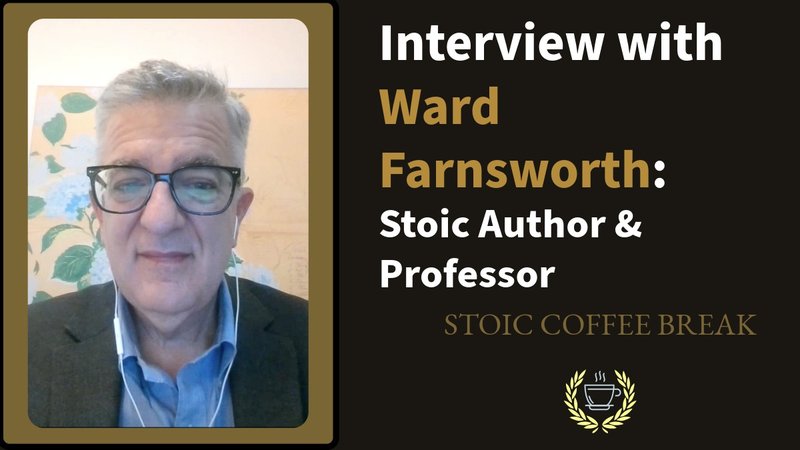
Ward Farnsworth is Professor of Law and holder of the W. Page Keeton Chair at the University of Texas at Austin. He's the author of several books on philosophy including The Stoic Practice and The Socratic Method. His new book Should You Tip For Takeout? is a guide to seeing the applications of philosophy in everyday life. Join us on this wide ranging conversation about philosophy and how you can become a better thinker!
Transcript:
Erick: Hello, friends. Welcome to the Stoic Coffee Break. My name is Erick Cloward. So on today's episode, we are going to talking, be talking with Ward Farnsworth. Now, I got introduced to Ward a few years ago when I picked up his book, The Socratic Method, one of the things that struck me about it is, if you don't know, if you haven't heard of Ward, he's written several books that are very influential in philosophy.
He's a you're a professor in Texas, from what I remember, a law professor… are you retired now?
Ward Farnsworth: Far from retired. Yeah, I'm a professor at the University of Texas
Erick: all right. But one of the things that I really loved about the Socratic method was when I was younger, I always used to think that philosophy was something that was, way above my head. I'm just not smart enough for philosophy. And then when I f- stumbled onto Stoicism about 10, 12 years ago and started reading about it, it was like, "Oh, this is a very approachable philosophy." But then I, then as I learned more about that and got better, then I was like, "Oh, but Socrates, he's, he's way up here. I... There's no way I could ever think like him." And then I got your book, and it was like, "Oh, okay." It was approachable, it was readable, and it was one of those things that helped me to really understand the way that Socrates thought and just the way that he approached life.
So one of the things that I appreciate about your writing is the fact that it is so approachable. Even though you have a law degree, you don't write, in this very, very high jargon. It's that nice of intelligent but approachable, and that was one of the things I
Ward Farnsworth: Well, thanks, Erick. I try not to write like an academic even though I am one
Erick: Exactly. sorry, that was me kinda fan- fanboying over here about about your work. But I really appreciate you coming on the podcast today, so we're gonna discuss a few things. obviously, you've written the book, The Practicing Stoic, which is very well-known in stoic circles. We can go ahead and dive into that for a little bit, and then near the end, we can talk a little bit about your new book that's coming out soon, which I'm really excited to get a copy of.
Ward Farnsworth: All right. Sound, sounds great. Yeah, The Practicing Stoic, I'll just sketch briefly for those of your listeners who aren't familiar with it and might be interested. The concept of the book is to take the the great surviving Stoic writers and what they had to say about various topics and put them together so that if you wanna see what they all had to say about externals or what they all had to say about death or emotion or adversity, it takes those, those topics and it assembles the basic ideas of Epictetus, Seneca, Marcus Aurelius in one place.
You can kinda compare what they had to say about these things and see it all in one spot. It also brings in some other writers who I wouldn't quite describe as Stoics, but I describe as descendants of the Stoics, people who were interested in the Stoics Schopenhauer or Samuel Johnson, and shows what they did with some Stoic ideas, 'cause it's interesting to see how these ideas have lived on and been used by others.
So it's a reference book, but it's meant to be a browsable reference that you could open anywhere and enjoy and learn from. 'Cause, if you read the Stoics in the original, it's not well organized. They didn't do their writings in a way that was meant to make it easy for somebody to learn from.
Like the the letters of Seneca, they jump all over the place. The Meditations of Marcus Aurelius they're they jump all over the place also. So if you just wanna see what did these guys think about some particular angle of thinking about death, they don't set it up that way for you.
And so the book I've written, The Practicing Stoic, is an attempt to make their teachings easier to digest by pulling those ideas together in one spot with some commentary and context around the edges to make it a little easier to understand. That's the idea. My hope is it's an entry path for people who are interested in reading the originals but might find it helpful to see them presented in a way that's organized in a manner that's more intuitive than the way they put it forward.
Erick: Excellent. So in your kind of teaching career along with... Now, do you actually teach philosophy or do you just teach law,
Ward Farnsworth: I've taught stoicism, I've taught stoicism for lawyers at my law school. It's,
Erick: Oh,
Ward Farnsworth: a, a class lawyers need very much
Erick: Yes. Agreed. I think there are a lot of, I think we can definitely lump politicians in there, and that would probably make our world a bit better for sure.
Ward Farnsworth: The, yeah, there might be no class of people that wouldn't benefit from stoicism for them. But since I train lawyers, I do it I do it for lawyers
Erick: True. In teaching, in many, your many years of teaching, what do you think is the most difficult piece for people to latch onto in stoicism? Or what seems to be the biggest stumbling block or hurdle that they have to get over to actually, take these ideas and actually apply them in their lives?
Ward Farnsworth: it's hard to generalize because everybody's got their own blind spots. Seneca talks about this, that it kinda, there's no one thing everybody needs. There are people with different temperaments that have different issues, so I try to work with each student to figure out where's the helpful part and where's the difficult part that I can be helpful to them on.
What I do think f- is probably true for most people is it's just getting over misconceptions. As we all understand if you're listening to this podcast, the word stoicism is an unfortunate one now for this philosophy because it has an English meaning that makes it sound like it's all about the grim endurance of suffering or something like that.
And of course, that's really not the spirit of it. I think of stoics as a good-humored bunch. Getting people to put behind them the sense that stoicism is about gritting your teeth and helping them understand it's really more about changing your relationship to the way you think and that this is something for everybody.
That's, I think the sort of initial ice that has to get broken
Erick: Yeah. I know for me, before I, I found stoicism, it was the same thing that, I always heard the term stoic and just immediately knew that it was somebody who was unemotional and, know and basically like a rock. And that was actually the thing that got me into, was that Tim Ferriss mentioned William Irvine's book A Guide to the Good Life: The Ancient Art of Stoic Joy, and said this book changed my life."
And I was like, "Stoic joy? What? That doesn't make any sense. Why?" And so that, that was the thing that piqued my interest. I was like, "Okay I guess I don't understand what stoic actually means." And then I read the blurb on it, and I was like, "Okay," I bought it. that was my introduction to stoicism, and I just I remember also bought the audiobook, and I would come home from work and, listen to it on the way to and from work, 20-minute drive. And I would have those light bulb moments, where I'd sit in the car park and, I'd park my car in the driveway and "Oh, okay, and, and listen to that section get finished. it was just amazing to me that it was such an approachable philosophy, and that there was a point where I just realized, I'm like, "I've been looking at the world the wrong way," the, kind of the big
Ward Farnsworth: Yeah.
Erick: for me
Ward Farnsworth: Yeah. I think that's a revelation maybe for everybody. You meant-- You talked-- You asked what's the hardest thing. I suppose the hardest thing for the beginner is also the hardest thing for the non-beginner, everybody else, which is not taking your reactions for granted and getting...
stoicism calls for a kind of separation from your automatic reactions to things and realizing there's a third step in there, which is the, the, the judgment you interpose between the event and your reaction to it. And it's like re-re-remembering that you're wearing glasses and the... and you forget that you have the glasses on.
And I think actually for all of us it never stops being challenging to remember that, that sort of stoic practice and discipline. And I…, and for a lot of people, it's astonishing to even think about it for the first time because they've never really reflected on it. That's why Montaigne, who is a, this great French essayist, he figures very prominently in the practicing stoic.
I wouldn't call him a stoic because he wouldn't have called himself a stoic, but he loved the stoics. And in the rafters in his, in the room where he did his writing, he'd etched in ancient Greek the saying from Epictetus that we don't react to events, we react to our thoughts or opinions about events, and those are up to us.
So he could lie there when he was writing, and he could crane his neck back and look up at his ceiling, and he could see it written there, 'cause even Montaigne needed that reminder. There's nobody who doesn't
Erick: Yeah. Yeah. And it was probably one of the biggest challenges for me in trying to become more stoic was I used to be very reactionary, and a lot of that was because of my dad was very much that way. Everything was very emotional. And unfortunately, it, there was a lot of chaos growing up, and so that was what I knew. It's, for me, what stoicism offered was a way to thoughtfully and rationally examine how I was feeling about something. it took me a while before I could do that in the moment, but I could at least afterwards, at the very beginning, I could at least afterwards look at something and start dissecting it and going, "Okay, why did I get so upset about this thing?"
"It w- wasn't really that big of a deal. What was the story that I was telling myself about this thing?" And then I would go, "Okay, I made the assumption that they meant this," or, "I misinterpreted this," or, " I was already mad, and so I was just looking for anything I could take to throw it back in their face, and so I twisted this around." And so that, at least that very beginning of the metacognition to be able to go, "Okay, what was I thinking at the time? is it wrong? And what
Future hopefully to change that story?"
Ward Farnsworth: Yeah. It's very liberating stuff. That's what Epictetus always said is this is a kind of a, a path to liberation. And for some people, it's about learning to manage their anger differently because things that set them off, they learn to slow down and look at and ask "What's the judgment that's making me think this is worth getting angry about?"
For some people, it's not about anger. It's about being anxious or about being depressed or being fearful or being grasping and acquisitive. Everybody's got their different demons, but stoicism's helpful for all of them
Erick: Yeah. other thing that I appreciated about the Stoics was their clear view on virtue and what that actually meant. Maybe you could explain that if somebody was listening to this for the first time, what the Stoics mean by virtue and your take on those things
Ward Farnsworth: Yeah, that's right. The Stoics think of virtue as the only real good. If you think of money or health as a good thing, they would say, "Not so fast. It can be good depending how you use it," but you can also think of somebody using wealth or their health even in a, in, in terrible ways.
So those must not be really good on their own. It's all a question of what you do with it. So if you go back to things that are just good in themselves they have their cardinal virtues of, justice, courage, temperance, wisdom. Those virtues are not unique to stoicism.
They're classical virtues. The stoic ideas and the, the book discusses them. The the distinctive feature of stoicism is treating those things as the only really good things. What I find most interesting and helpful in the stoics when they talk about this is what Seneca says, where he says because they have some other ways of thinking about what virtue is or what the virtues are.
And Seneca says, I'd be willing to trade all the ancient definitions of virtue just for consistency." Just that if you were willing to live by all that you, all, all the words you use so you never contradict yourself. He said, "I think that would probably take care of most of our virtue problems."
And it's interesting to think about that, whether is it really true that somebody could be consi-- if somebody's perfectly consistent, they're gonna be a virtuous person, or could you be perfectly consistent and be a bad person? And people can think about that. But the, I think for most people what Seneca would say is, "Look, if you're never a hypocrite, you'll probably be a good person."
And if you think I don't know about that," he'd say, "Why don't you, why don't you try it and come back? Come back when you're never a hypocrite, and then we'll... If you're not, if you're not a good person, then we can talk about stage two." But most people never make it past stage one. And it’s.., the reason I like that is it's very Socratic.
You read that book, you mentioned that book on the Socratic method. Socrates is all about bringing people into alignment with themselves and about using consistency as a way to create virtue and say, "Is what you're, is everything you're doing consistent? Is it all consistent with what you're saying to yourself, saying to others about what the right thing to do or the right way to live is, about who you admire and why?"
If you bring all that stuff into consistency, you'll probably find yourself acting admirably and virtuously. And so the whole Socratic method is forcing people to be consistent by asking them questions about what they think about this and how that compares to what they say about that, and then challenging them to square these things.
And then as they square them and have, have trouble with it, gradually co- eradicating, rubbing out inconsistencies and getting closer to the truth. Never quite reaching it probably, but getting closer and closer to it. So Seneca has what I consider this Socratic idea or definition of virtue that I'd regard as very appealing because it's something everybody can do more easily.
A lot of people might say, "I'm not really sure what justice is," and that's right. A lot of people, none of us perhaps, depending on the occasion, can always be sure what justice is. But we can always challenge ourselves to be more consistent And if you're doing that, you're on the right track, you're on the Socratic track.
And the Stoics regarded Socrates as their heroes. One reason I wrote the Socratic Method book is it's a prequel to the Practicing Stoic. The Stoics considered themselves descendants of Socrates and carrying out his mission in a more detailed, way. They weren't the only people who thought of themselves that way, but they did think of themselves that way.
So if you really want to understand Stoicism, I think you need to go back to Socrates. That's what... I think that's what they would have said. And there's a lot of consistencies and a lot of influence. If you read Epictetus' discourses, you'll see a lot of Socrates in there, a lot of Socratic questioning by Epictetus of his students, a lot of the use of consistency to force people to realize the truth of a lot of Stoic sayings, things like that
Erick: it's interesting now that you brought up consistency because I was having a discussion a couple of months ago with some friends of mine, and I was talking about the idea of teaching leaders, h- why you would teach leaders to, in a virtuous way. as we were discussing, if you follow the four virtues, what would that actually bring to a team, for example? as I was explaining, it really came down to trust, that y- when you have a high-trust team, then even if somebody is like a curmudgeon on the team or, maybe they're not... You don't necessarily have to like them, but if you trust them, you're still gonna get really good work. you may have personality conflicts of other things. Just because you're both virtuous people doesn't mean you're necessarily gonna get along. But if you know that you can trust that person 100%, then you're willing to put up with maybe the, the friction that you have between each other. And so I like that idea. But a lot of it comes down to consistency, meaning if somebody is consistently a curmudgeon and they just are who they are all the time, then you can trust that. You can be okay with "Oh, I know this person is consistent in their behavior, and they're always gonna be like this," and that, that makes it much easier to trust them. Which then sometimes when people are inconsistent, that's when we find it challenging. Or when they've been consistently one way and they decide that they wanna change, we oftentimes have a hard time with that change as well.
Ward Farnsworth: Yeah, true enough. And there's different kinds of consistency. W- there, there's consistency where you're gonna be the same kind of person each day, and there's consistency between what you're doing and what you're saying, including what you're saying to yourself.
So Seneca said, it's very few people who could live with their door open. And in other words, figuratively, if people who could live so that everybody could see what they're thinking and doing at all times and not be surprised by any of it and not be disgusted by any of it. He said perhaps nobody can. But if you get closer to that ideal, you're probably closer to being virtuous even without having philosophized or thought about d- virtues in detail
Erick: Yeah, but that it does bring me back though to the person who's consistently evil. Yes, they are exactly the same, so would they be considered virtuous? And I, So I'm not quite sure if I agree with Seneca on
Ward Farnsworth: Yeah. It's a nice, it's a nice problem. Yeah,
Erick: yeah.
Ward Farnsworth: I agree. It's an open, it's an open question. But I think what he'd say is "Bring me that person, and then we'll talk about it." Bring me the person who's genuinely consistent, who... Because most people at least aspire in their hearts and their minds, apart from their behavior, to certain kinds of ideals.
And if they, i- if somebody really abandons those, you can think of a hypothetical person like that. But usually he'd say, " If I-- Give me a chance to question you." That's what Socrates would say. He'd say, "If you bring me somebody you think is consistent and they're evil, give me a chance. Maybe they haven't been questioned by me. Let me see how consistent they are." 'Cause Socrates was a master of cross-examination, and I think he'd usually be able to tie that person in knots. Anyway, it's a, maybe it's a shortcut. Maybe it doesn't always work, but I think for most of us it's very helpful
Erick: Yeah. As I became more and more comfortable and familiar with the stoics I found myself definitely drawn towards Socrates over Plato or Aristotle or any of those, simply just because he... His ability just to see things in a very clear way, and not necessarily that he had to know everything, but just his, the like you said in your book, the, the method, the methodology that he used to be able to do and to be able to talk to people about these things I found just tremendous, and it's something that I try to do better with when I'm talking to other people.
But I do find that I know a lot about a lot of things, because I'm curious and I read tons of books and all this stuff, that sometimes I do get on the path of here's the answer. Here's the answer. Here's the answer," rather than going, asking the questions and helping them elicit their own answers, and that's what I try to do better
Ward Farnsworth: That's great. I agree. The, part of the point of the Socratic Method book is, I think Socrates and the method have a lot to offer right now, just all the time in conversations, with your crazy uncle at the Thanksgiving dinner table. Because the Socratic method is not really about arguing directly.
A lot of people had a little exposure to the Socratic dialogues maybe in college or something, and they come away with the impression of Socrates as being a irritating character. And he can be, but I think the Socratic method at its best is non-confrontational, just asking questions.
Not in the obnoxious just asking questions sense, but in the sense of saying, "Look, can we agree on this? Let's try to find something we can agree on first. And then if we can agree on that, let's think about whether that's consistent with this other thing this that you've said." So you're trying to gently get concessions from people and co- find common ground and stand next to them.
You're not trying to-- You're not looking across from somebody as an adversary. The Socratic posture is you're standing next to them and trying to find the truth together by finding something you can agree on, and then comparing what you disagree about to this thing you agree on. So I think it's a great way of peacefully working your way through disputes and, more fun, too.
There's a great line from Ben Franklin, who said that reading the Socratic, about the Socratic method really changed his life, 'cause it had taught him instead of arguing with people, to elicit these concessions. And he said it gave him victory in arguments much more often than he deserved, because these skills are like a, he didn't put it this way, but it's like one of those martial arts that uses the weight of somebody else against them, so you don't
You can, you be very successful with, even if you're not big and tough. And he said, "I was amazing at this. I wasn't necessarily formidable, but I always seemed to come out on top." He said, "Eventually, I stopped doing that to people, and I started just using the Socratic method as a reason to be humbler and more diffident and less demanding of others and less positive in my manner."
And he said, "I think I owe a lot of my success in life to just being a more Socratic kind of person," which just means a humbler person. Socrates was declared the wisest in Athens 'cause he was the one who de- who denied that he had wisdom, and Ben Franklin got a very long way with that kind of humility.
And that's part of the point of the book, is that the Socratic method, if you really take it for all it's worth, it's not just a method, it creates an ethic, and the ethic is some skepticism, some doubt, some humility, really attractive qualities that are probably, I think we can agree, in short supply in our political culture these days.
Erick: Very true. But then that begs the question, we tend to follow people who are very cocksure about themselves and don't have that humility and don't carry that nuance. And often people who do have nuance, they get on a news program, it's like said this," or, "What do you think about this thing?"
And they go, “Too complicated." We've... And they try to show the nuance and, how do you deal with people who either, one, don't act in good faith because they're, they're ideologically driven and they, and I understand that. I grew up Mormon, and, had this blind faith on for so long, and once I took it off, it was like,“I can't believe how arrogant I was to think that I was so right."
And then number two, if they aren't in good faith, is it still applicable to them? And, is this something that can be used on them? Because even if you do bring up evidence, and I've seen this before in different conversations. There was guy on, a YouTuber called Dr. Mike, and he's an actual doctor, and he was in a debate, and what I loved about him was he seemed very Socratic because, know, somebody would come, they'd sit down, and they'd be like I think this."
And he would go, "You know what? think this as well, but here's the part where you need to understand that, yes, this is a problem, but let's take a step back." And he was really good at first agreeing with them and then showing those differences in a way and bringing them along for the ride, and I was so impressed with that. I find that sometimes people just don't want to change their mind, and how do you deal with them?
Ward Farnsworth: Yeah, very true. I don't think the Socratic method is the right tool for every occasion. It's my favorite tool, but I've also written a book called Classical English Argument that's a catalog and a discussion of all the classic argumentative techniques through the ages illustrated with classical, classic examples from the founders and others in the history of English and American debate and oratory.
'Cause I think if you wanna make your way rationally in this world, you need a complete toolbox. A Socratic method's not gonna get it done. It's like there, there are tools you don't bring to a bar fight. It's not gonna get it done. You'd like to turn everything into a Socratic conversation.
Sometimes there are people who won't have any of it, and then you've gotta have a wider range of verbal and logical tools available to deal with those situations. So I've got a book for that occasion, but it's a different book
Erick: Nice. Did you by chance quote St- John Stuart Mill in that?
Ward Farnsworth: a lot of John Stuart Mill. He's a hist- he's one of the heroes of that book. So if you're a fan of Mill and of the founders and how they reasoned and argued Classical English Argument is a book you might like. It's a little similar to The Practicing Stoic in how it's structured.
It's a lot of examples put next to each other of different themes being used in argument and debate and logic and em- emotional appeals and all the rest. That's why I like to teach, is by example. That's why The Practicing Stoic, it's got a little bit of me, but it's more a collection of the best of what the Stoics said on various topics, and the argument book is very similar.
It's... I try to provide context and commentary, but what I really wanna do is show illustrations everybody can learn from of argument at its best
Erick: Nice. Yeah, one of my favorite quotes basically it's the definition of steel manning, is from John Stuart Mill, where he says, if you can't articulate the arguments from the other side, or even if you are completely unaware of them, then you have no business preferring one opinion over the other."
Ward Farnsworth: Yeah, the man the,
Erick: right there.
Ward Farnsworth: I think it's like the man who knows... Yeah. No, sorry. I think it's the man who knows only his own side of the argument knows but little of that. It's a it's a very beautiful idea, and that, that's in the book. Yeah
Erick: Yeah, that was, when, I remember when I first read that I read the shortened quote, then I read the whole thing out, and I was just like, "Oh my gosh, that is so brilliantly written." I just, yeah, and it just rang so true
Ward Farnsworth: Yeah, and John Stuart Mill said that the meditations of Marcus Aurelius are the highest ethical product of the ancient mind. And he ought to know because he was a master of ancient Greek, and he actually, Mill did tran-- A lot of people don't know this, but Mill published English translations of most of Plato's dialogues in his lifetime, 'cause he didn't think there were good ones at that time and commentaries on them too.
So if you're a lover of John Stuart Mill, and I think if you love the Stoics, you probably should be. Or if you're not, you might wanna spend more time with him and see. He's got a lot of interesting things to offer, and the book on the Socratic method has a lot of discussion of John Stuart Mill in it
Erick: Wow. More books to add to my reading list.
Ward Farnsworth: So yeah, I try-- Look I consider Stoics kind of my tribe. People who like Stoicism, or at least some of them, are my tribe, and I try to write books that are treats for my tribe. Socratic Method book's like that. The Argument book is like that. I've got a new book out called "The Latin Tamer."
It's a book about Latin, how to read Latin, and it's full of... Unlike other books about Latin, it's full of examples from the Stoics. When you-- if you want to learn Latin, most books about Latin are just introducing you th- via Caesar and then Virgil, and that's great. But if you're attracted to Latin because what you really want to do is read Seneca in Latin, what he actually said, there hasn't really been a book for you, but now there is.
And there's a website I should mention called latinlanguage.org, where you can find all the illustrations from the book for free. And all-- in my book, "The Practicing Stoic," of course, there's hundreds of quotations from Seneca and Cicero that were originally in Latin. All of those excerpts are now at The Latin Tamer website.
And you can click on the words to see what they mean in English, and you can click on audio to hear how they might have sounded in Latin. Entertain-- This is-- I don't say you need this if you want to study Stoicism, but if you love the Stoics, you might enjoy the chance to begin to learn something about how they said what they said when they originally said it.
It's fun, and it's interesting, and it's one way to bring you closer to their teachings, is to get a little up, more up close to them by learning something about how they expressed themselves.
Erick: Interesting. Yeah, I remember I had in eighth grade we had a we actually had a quarter of Latin, and I found it so interesting because it felt like a very logical language,
Ward Farnsworth: Right
Erick: y- and then we moved to Span- I think we moved to Spanish and then later on in French, and they se- they seemed to latin seemed like the rule and the others broke down, and there were exceptions and weird things that would happen. But I remember, because I was always really good at math, that I always thought that Latin is just such a mathematical language,
Ward Farnsworth: Yeah
Erick: everything resolved really nicely, and maybe it's just
Ward Farnsworth: That's right
Erick: became a dead language and then, so it never changed, and so they kind of
Ward Farnsworth: Yeah.
Erick: rules while they had them
Ward Farnsworth: Absolutely. Yeah, Latin has is a fascinating thing to study at any age because the words sort of interlock. In, in Lat- in English the meaning of a word depends just on the order the words are in. So if you wanna say the gladiator ate the lion or the lion ate the gladiator, the only difference between those sentences is the order of the words.
That's how you know who's eating whom, is that w- what the eater's first and the person getting eating whoever's getting eaten is second. In Latin, it's not like that. The words... the meaning of a word is determined by its ending. So you can put the words in any order you want, and they still mean the same thing 'cause the ending, there's a different word for a gladiator if the gladiator's eating or being eaten.
And you gotta learn all those endings. But what that means is that once you understand the endings, all the words in a sentence fit together like puzzle pieces. They kinda snap together, and that snapping sensation is one of the great satisfactions of understanding Latin. Seneca was a real master of this.
He'd write these beautiful sentences. If you enjoy Seneca in English, if you ever read some Seneca in English and think, "Wow, that's beautif- beautifully said," wait till you see how he, how it sounds in Latin, where the pieces all snap together and he's, and he was a r- Seneca was a very influential prose stylist in ancient Rome.
People really loved the way he wrote. And so my website and the book try to bring that within easier reach, where it puts a lot of Seneca on the page. And then even on your phone, you can just touch the words in Latin and have the English pop up above them. And you can say, "Wow, that's how he said it."
It's fun
Erick: Nice. Yeah, I do. I think out of all of the stoics, I would say that Seneca is probably the best writer. I think Epictetus is probably the most like Socrates, especially in kind of temperament and humor. But then it feels like Marcus Aurelius is kind of the heart of stoicism. He's the one who's got the, the heart of it, whereas Epictetus is a little more on the logic side of it, and, Seneca has the flourish, if you will
Ward Farnsworth: yeah. The Practicing Stoic suggests at one point that each of the great Stoic teachers who survived to us, it's almost like they have specialties. They each have topics that they're stronger on or spend more time on than the other. For Epictetus, it's externals. If you really want to understand the idea of externals in Stoicism, you have to read Epictetus.
Seneca is more the psychologist of the Stoics. If you want to understand the psychology of desire or of emotion, Seneca is the one who wrote the most about that. There may be others who wrote even more from the Greeks, but we don't have most of them. Of the ones who survived they each have their specialties.
And most people, if they read the Stoics for a while, come to... You enjoy all of them for different reasons, and usually everybody's got their favorite
Erick: Yeah, I go back and forth on him because they just, I think at different things that I need in my life. But yeah, I appreciate Seneca, his flourish in his writing. But also Musonius Rufus, I really appreciate his compassion, and his just almost Cato-like iron will, while still being a very s- from what I under- from what I could tell, a very compassionate, very tender person, but also very solid
Ward Farnsworth: Yeah, and welcoming of women into Stoicism, which is a great thing in ancient times or now. Yeah, I should have mentioned Musonius Rufus also appears in "The Practicing Stoic," just not as often as the others because we don't have as much from him
Erick: Yeah. but I remember I stumbled onto some of his stuff and I was just like, "Oh, that's brilliantly said. Wow. Okay,
This guy was sharp. He wasn't just a farmer. He was very sharp."
Ward Farnsworth: Yeah. A lot-- These are brilliant people. And you mentioned Seneca being the best writer. What you have to remember is what we have from Seneca are his writings translated into English. When we're talking about Epictetus, we really don't have his writings. All we have are notes from his students.
And the notes are still... I think we-- I like to think 'cause there's sort of a voice that, that cuts across the notes. So I think the notes are pretty authentic, and they're fun to read because the, the personality of Epictetus comes through. But what he was like as a writer, we don't really know,
Erick: Yeah
Ward Farnsworth: more than we don't really know what Socrates was like as a writer.
All we have is what he said as recorded by Plato or Xenophon
Erick: Nice. let's see. I'm looking at time here. So we probably
Ward Farnsworth: Oh
Erick: minutes
Ward Farnsworth: This, I have this other book out we should talk about.
Erick: Y-
Ward Farnsworth: How about that?
Erick: what I was gonna bring up
Ward Farnsworth: Yeah, okay. Yeah, I said I try to write things Stoics can enjoy. There's this new book that I've written with an economist a law, another law professor and economist named Saul Levmore, and it's called Should You Tip for Takeout?
Which might not sound like a book about Stoicism, and it's not. But I think it's a book Stoics would enjoy because it's about rationality in everyday life, how to think about everyday questions like tipping for takeout or whether to recline your seat on an airplane in ways that are very rational, and how to learn some lessons about rationality from these little problems that you might be able to apply to bigger ones.
It's supposed to be a recipe for interesting dinner conversations, 'cause in the end, we can only spend so much time at the dinner table talking about politics or about whether AI is gonna kill us all. Eventually, it's nice to have some other things to talk about. And I think these everyday conundrums we deal with, they're interesting to break down and look at.
Seneca said "Virtue is the use of right reason," and the question is: What does it mean to reason closely about little things like whether you should let somebody cut in line in front of you if they're in a hurry? The, the... I know these questions seem comically small, so in some ways, I think this book is entertainment for Stoic types.
But I think if somebody enjoys at least the other things I've written about the Stoics they might have some fun with this book too
Erick: I think one of the things that, that I can appreciate about that is, so like I said, last week I had Andreas Kuusk on my podcast, and he a thinker, a meta thinker and so on. And w- and part of our discussion, which I thought was so interesting, i- is that, we were talking about cognitive mistakes that people make, and one of them is confusing an outcome a good decision. I was like, "Explain." And, and as we talk through that, it's the idea that too often we judge a decision as being good if the outcome is what we want, a bad decision if the outcome isn't what we want. Whereas we should judge the decision based upon its own singular criteria, because you can't control the outcome. You could make a
Ward Farnsworth: Absolut ja
Erick: perfect decision. You could do everything perfectly and still not win, and that's okay
Ward Farnsworth: Yeah, the book talks a lot about that. We call it the ex ante perspective, which is judging a decision ex ante, which means how it looked from the beginning as you entered it, not with how it turned out. So if you buy a lottery ticket, it's a bad decision. It doesn't become a good decision when the lottery ticket pays off.
It's a dumb decision that turned out well. And if you make a great decision that turns out badly it doesn't mean it was a bad decision. It was a good decision that turned out badly. And that if you're a stoic, you've got to remember that because if you make good decisions or the right decision, it's not always gonna turn out well.
And you gotta judge these things rationally based on how it looked on the way in. Say something similar about blame. There's some interesting philosophical problems here where you think about somebody who drives drunk and runs somebody over. Should you be any angrier at that person than you are at somebody who drives drunk and doesn't run somebody over but who just as easily could have?
They made the same bad decision. One of them had a worse outcome than the other, but th- that wasn't because of anything they did. That was just luck. So should-- Now maybe the, the real answer is don't be angry at either of them if you're a stoic. Okay, put the anger to one side, but sh- should you respond differently to these two people?
Should they receive the same-- If you're really a stoic or you're just thinking rationally about justice, should we r- should we deal with these two people the same because they basically made identical decisions? Everything that was up to them, they did the same way. Everything else about their story was simply a question of whether there was somebody unfortunate enough to be in the way of their car.
So the, the book talks a little bit about that too, but that's part of-- that's a major theme in the book is how you evaluate decisions and from what time standpoint. It's a hard discipline because as humans, it's-- e- even when you're thinking about something more trivial like sports and a decision to make a trade in baseball.
You make a trade. Everybody thinks it looks great. Then the pitcher's arm gets blown out. Says, "Oh, what a stupid trade. Fire the GM." Look, you got to evaluate that trade on the day it was made, not on, not based on how it turned out. It was either a good trade then or it wasn't.
And the fact it didn't turn out doesn't change the quality of the judgment at the outset. I think we all understand this sometimes. It's very hard to remember when you're staring at a terrible outcome of a good choice or at or at a a great outcome of a bad choice. Somebody gets up at a sporting event and does something really stupid, and it turns out great, and they get carried off on everybody's shoulders like a hero.
That person should not be considered a hero from a rational standpoint. That person did something very stupid that turned out in a very fortunate way. But we humans have a very difficult time remembering that.
Erick: Yeah, because we do get stuck on the outcomes because that's proof, if you will. The proof is in the pudding, as they
We get stuck on that that all good outcomes came from good decisions rather than just know... And that's why I appreciate people who, you know... Excuse me.
Of the things I do is business coaching, and oftentimes when I'm working with leaders, they'll talk about a certain role model that they had and so on, and, they read this biography by them and so on. And I think that there's a problem with that in that, we lionize these people who are successful, so there's, there's survivorship bias as part of that.
Yes, they happened s- they just happened to get lucky and survive, and so we look at them as successful, there are plenty of other businesses that went under just because of unfortunate circumstances that nobody had control over and that couldn't
Ward Farnsworth: Right
Erick: but then oftentimes, the person just happened to stumble into success, and so then we...
But then we go back and we connect all these dots showing, creating this path, showing how they were brilliant at what they did. We create a narrative around these things to try and make sense of it,
Ward Farnsworth: Of course, yeah.
Erick: sense. They just got lucky
Ward Farnsworth: No, there are a lot of people who are regarded as geniuses who were mostly in the right place at the right time, and and then success begets success. And I think part of stoicism is being able to see past that. Montaigne says you gotta look at the person and not the, the pedestal they're on and Seneca said something similar.
It's hard for us to-- humans to remember these things. And I think, the sto- stoicism has a lot in common with modern cognitive psychology. If you read work by people like Daniel Kahneman, a lot of that, when you read it, feels like elaboration of a lot of insights the stoics had about tricks we play on ourselves and ways that our minds betray us.
And this book about tipping for takeout is about other examples of that. It's about how when you make decisions in everyday life, it's very easy to be irrational without realizing it. And so slowing down and looking at those things more closely, it's interesting. It helps you make better decisions, which I think is worth it for itself.
But it's also just interesting to think about how do you practice rationality just in your ordinary dealings with the annoyances that come your way on a day-to-day basis?
Erick: Yeah. Yeah, definitely. And that for me was a really part of stoicism, is because like I said, I was always good at math and logic and those types of things. Geometry was the easiest class I had in high school, and all geometry is just logic with shapes. And so being able to reason that way, but then I had, all these strong emotions on the other side, and I'd...
and so oftentimes act completely irrationally, and it was really frustrating because I didn't feel like I could control those things. And while stoicism gave me a lens to be able to see those things better it didn't... It still took me a long time to get better about those things. But what I appreciate about stoicism was that it gave me the tools to actually examine my thinking more clearly, to understand those stories, and to figure out, and dig deeper than I could oftentimes in therapy w- with a therapist. I was able to finally discover, okay, this is what's going on. This is the actual... be able to walk back through that story and go, "Oh, okay. Five levels down, this is where it's really coming from, and this is why, I got so upset about that thing," which I look back later and go, "It was small thing, so why did it, why did it push that button?"
Ward Farnsworth: Yeah. A lot of good therapy resembles stoicism. As you may know cognitive behavioral therapy, which is a very powerful tool, is pretty explicitly a descendant straight from Epictetus. I think that the founders of that school of therapy were explicit about that. So a lot of people find these things helpful for similar reasons.
Erick: Yeah. And for me that, yeah, that's very true. And so that's why, i'd started this podcast just because I wanted to create a podcast, and stoicism was what I was studying at the time. And so I was like, "Oh, I'll just talk about that and make it a practice podcast so that I'll know what to do when I wanna start my real podcast."
And then this kind of took off, and here I am.
Ward Farnsworth: Yeah
Erick: yeah. And so it's been quite an adventure for me because I finally found felt like I had a lifeline that I could hook into finally get more control of my life. And a lot of that was just recognizing there were so many things that I couldn't control. So
Ward Farnsworth: every- everybody, everyone needs a way to practice and your podcast is a good way to do it
Erick: Yeah. Yeah. And some people ask me that how do you get good about implementing these things?" And I say I kinda cheat." And they're like what do you mean?" I said I do a podcast every week on this, so I'm constantly sitting down and writing and thinking about it." And probably 80% of the podcast episodes are me running into a problem and sitting down and trying to figure out how to use stoicism to help me solve that problem, and then that turns into an episode. Because I'm like,
Ward Farnsworth: Good
Erick: if I had this problem and I s- I made it a little bit better using these ideas, somebody else is probably gonna have this, so I better share it with them
Ward Farnsworth: Well the book on tipping for takeout's a little like that. It's 24 little problems that come your-- that, that come up in everybody's life and how to think about them super rationally. Not always with an answer, but with a way to take them apart and think about them. Hopefully useful for Stoics, but in any event a good time for Stoics
Erick: Nice. Trying to think of, I was thinking of a concept of a question I wanted to ask, and it slipped my mind. But I think know you've been around for a long time. You've been teaching these ideas, and with the world and the chaos that it's in right now, what is some advice that you, either from stoicism or just from you personally, would like to offer to people who might be listening to this who feel like, the world is in free fall right now?
Ward Farnsworth: Oh
Erick: many things going on, with politics, with economics, and, the AI bubble that's going on. We have, climate change and things going on with that. We have, war in Ukraine and, possibly a, an outbreak of the plague that, that could be happening here. It's very hard, I... for me even, and I know these things, and I think about these things a lot, to sometimes keep hope and not let those things get to you because there's so many things that are outside of your control
Ward Farnsworth: Yeah, true enough. Maybe what I'd say about that is that there's nothing really new under the sun, and that's something the Stoics said, that if you-- P-part of-- One of the, one of the satisfactions and some of the solace offered by Stoicism is you come back, you go back and you realize that there's nothing happening now that's any scarier than a lot of stuff that was scary at that, back when the Stoics were writing.
They dealt with a lot of existential crises. Eventually Rome fell, and they dealt with a lot of terrors in their lives people at that time. They were a lot more terrifying than most of what most of us deal with now. And Stoicism was meant for that. It was meant to be solace and help for people who had a lot more to fear than most people do these days.
That's something that all the Stoics say is that once you've lived for a certain amount of time, you've seen it all. You're gonna... You, you-- Because life repeats. The terrors of life repeat. They put on different masks. They take different forms. But fundamentally, the things that we deal with and that are frightening aren't that different in character from things that were problems then.
And that's why Stoicism in part is so interesting. It's a set of responses and remedies to problems that are as useful now as they were then because the fundamentals of the problems aren't that different, although the way they look is different.
Erick: Yeah. I agree with that. And I think that's what kind of drew me was that the fact that they were over 2,000 years old or, roughly 2,000 years old, they still make sense. There were so many moments when I, when I would learn a Prata principle, especially like the dichotomy of control, when I finally grokked that and it clicked for me, it was like, man," like I said earlier, yeah, I've been looking at the world so wrong, every- Yeah, and then it de- really changed a lot of my thinking I finally realized, somebody saying, "You made me mad," how stupid of a, of pr- of a pronouncement that was because it's no, they didn't make you mad. They didn't have a button they could just, push on their palm and suddenly, your anger and adrenaline started running.
It was like you were telling a story in your head, and that story is what got you angry,
Ward Farnsworth: You ma-made yourself...
Erick: to-
Ward Farnsworth: Yeah, you ma- you made yourself, you
Erick: that.
Ward Farnsworth: yourself mad. Yeah. Yeah
Erick: Yeah. Yeah. And I love the f- I love the way that it really just changed my perspective on so many things
Ward Farnsworth: Yeah. Same thing with the, what you were saying earlier. People are freaking out about what's going on now. I'd say you're freaking yourself out." And it's not the world that's freaking you out, you're freaking yourself out, and there are people who've had as much to freak out about as you do and manage not to freak out, and you can go study those people.
Those are the stoics
Erick: Yeah, and I think that one of the things that I also appreciate about the Stoics was that, the idea of... it's not just their idea, but of eudaimonia. That this is how to live a flourishing life, not just how to survive life. I think that we oftentimes, like you said we look at it as surviving the grim, dark, harshness of life, and it's like, no, this is just a way so that those things don't sink you so that you can spend more of your time living a joyous life and
Ward Farnsworth: Yeah.
Erick: the happy things
Ward Farnsworth: Yeah, that's right. You mentioned stoic joy before. I'm-- And as I said I consider stoicism a path to, as, as you put it, happiness richly understood. That's part of what the Socratic Method book is about is what does it mean to really be happy? It's not just a good mood. Might not even be a good mood.
It's a good life in response to which a good mood might be an appropriate thing. And so I think stoicism gives you resources for thinking about what it means to be happy and about finding it. It's not just about avoiding grief or dealing with problems, although it's certainly great for that.
It's also about finding as you say, joy, durable joy the kind of pleasure and joy in life that can't be taken away from you. That to me is what it's really about.
Erick: Yeah. Yeah, I think one of the, the big realizations was that the differentiation between joy and pleasure, we often confuse those two things
Ward Farnsworth: Yeah, there's a lot of Socratic dialogues about the relationship between those things, and that's a major theme, of course for the Stoics as well
Erick: Nice. All right. We're coming up on time here. Is there anything else that you would like to share with my audience? Something that you think could make their lives a bit better,
Ward Farnsworth: Oh, I don't know about that. We've had a good conversation, and I'm grateful for the time with you. I always appreciate the chance to connect to people who share the interests I have in stoicism and the the sort of stoic adjacent topics we've talked about. If there are those in your audience who are interested in any of what I've discussed, always happy to hear from them
Erick: Okay. And where can my audience find you on the internet?
Ward Farnsworth: Oh wardfarnsworth.com has links to all my books. I don't really have a social media presence that's where I'll have to leave it
Erick: No, that's great. So yeah, I'm still debating how much I wanna have a social media presence, but it's how some people find me, so
Ward Farnsworth: I'm grateful to you for having one. I'm grateful to you for having one. It lets me connect to your audience
Erick: Yeah it's a bit challenging though, because I do find, I found recently that I have been spending way too much time on social media. Like walking around, as I'm doing chores, and I'll s- be scrolling YouTube videos, and I'm like, "Why am I doing this? Why can't I just, just
And listen to it while I'm doing other things?"
That's fine, but it's, is a very addictive technology. And so I'm often torn about that. Do I wanna have a social media presence because am I contributing to the problem? From a stoic sense, they're just externals, and what you do with them is up to you.
Ward Farnsworth: Yeah
Erick: because they a- they do have that addictive quality
Ward Farnsworth: That's true. There's a chapter in "The Practicing Stoic" on valuation, and it discusses the Stoics' attitude towards time. The Stoics, especially Seneca, they're very jealous of protecting their time, and they consider time more... Time is the most valuable thing we have. It's really all we have.
More it's the main use of money is it can buy you more time and more control over your time. And Seneca says, "If you have any doubt about this, go find somebody with a lot of money who's running out of time, 'cause they're g- they think they're gonna die soon. And notice they'll give up everything, all their money, for a little more time."
And so I think the rise of social media gives every practicing Stoic an opportunity to reflect on time and how they use it and what the value of it is. Because in effect, you're paying for your social media use, you're spending your time on it. And in some ways, I think when you step back, it's a source, it's a, it's an expenditure most people come to regret.
It's after they've spent it. After they've spent so much time on it, they look back and think, "I could have spent it better." And I think so I do think there's a Stoic approach to social media, and it involves looking back and asking if you treat your time as the most valuable currency that you've got is it well spent?
After you've done it, when you look back, do you feel like, "Wow, I just got healthier," or do you feel like, "Wow, I just ate a big bag of Doritos?"
Erick: I don't I eat Doritos every now and then, but that's because I'm a cyclist and that's one of my recovery foods
Ward Farnsworth: Yeah, now and then
Erick: and it dige- yeah, and it's easy to digest and it's great out on a ride. But
Ward Farnsworth: I don't mean to seem a- I don't mean to seem anti-Dorito, okay? Everything in moderation. Yeah.
Erick: yes. And I have one of those small little bags and it's, like I said, it's got lots of salts.
It's easy to digest when you're doing a 40-mile ride, so it's,
Ward Farnsworth: Maybe I should, may- maybe I should have picked a different example, but I think you got the...you see my point. You see my point, yeah
Erick: Yes, absolutely. Yes. But otherwise I don't eat Doritos because, I wanna make sure that my, keep my belly as small as I possibly can, but
Ward Farnsworth: Okay. I don't want any tr- I don't want any trouble with the Frito-Lay people. Let's leave Doritos out of this. But anyway
Erick: they're not gonna sponsor my show now.
Ward Farnsworth: There you go. Anyway, it's great to spend time with you, Erick. Congratulations on your podcast, and I-- thanks so much for having me on
Erick: Oh, I really appreciate you coming on here. So when I got the, like I said, when I got the note saying, "Hey Warren Schwartzer's written this book. Would you be interested?" And I was like, "Of course." I like, I, know, I... Like I said I got the Socratic Method and was just blown away at how well-written it was, and I was just like, man, he would be somebody great to have on my podcast.
And I thought about sending a note before, and so I'm really glad that you guys ap- approached me to, to come on here. That was... I really do appreciate you coming on
Ward Farnsworth: Oh, my pleasure.
Erick: with
Ward Farnsworth: Yeah, it's generous of you to have me. Thanks
Erick: All right. Friends, that's the end of this week's Stoic Coffee Break. As always, be kind to yourself, be kind to others, and thanks for listening.