
Transcript:
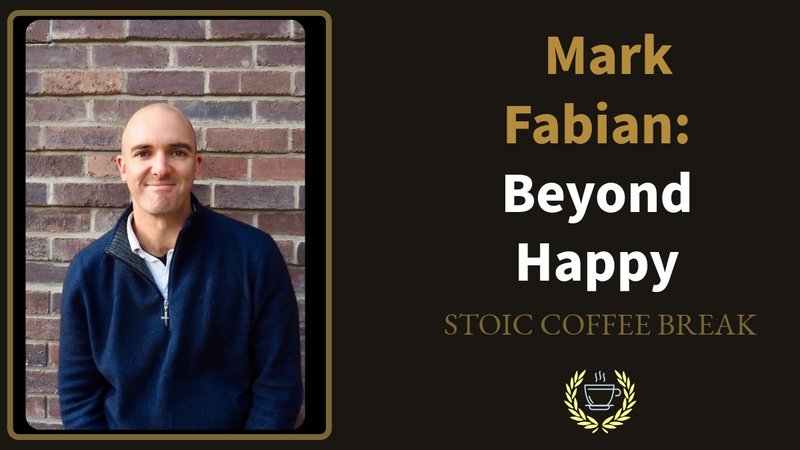
Erick: Hello, friends. My name is Erick Cloward, and welcome to the Stoic Coffee Break. So this week's episode, we are going to be having Mark Fabian on. Mark is an academic and the author of the upcoming book, Beyond Happy, which I've had a chance to read some of the, the, the early pre-prints, and I th-... Oh, there we go. Right. If you're watching this, you can see it up on the screen. And, it says, "How to rethink happiness." to rethink happiness and find fulfillment." So, which obviously is a, a big topic on my podcast, and Mark's contacted me, and I like what he ha- you know, what he put out there, and so I, I kinda checked him out online, and I think that it was a really good fit.
So I'm gonna let Mark, kind of finish the intro and tell us more about himself, where he's at, and what he's working on.
Mark Fabian: Yeah, sure. so I'm a associate professor at the University of Warwick in the United Kingdom, of public policy, but I have a mixed background. So my PhD was in economics. Before that I did philosophy. I've kind of self-taught in psychology in a lot of ways, and that's actually where I publish a lot of my work these days.
Erick: Yeah, I can definitely understand that. I obviously don't have an academic background in that. I got a degree in business and marketing and music, and then been a software developer for pretty much my whole career, but kind of my bonafides are I found Stoic philosophy and then started reading everything I could find on it, and then started this podcast and found that working on it every single week, I just really got... In teaching other people what I was learning, you know, it,…I did write one book, obviously not quite as academic as, as yours. What was your... So as I was reading the book, it talked about your previous book, which was much more academic,
Mark Fabian: Yeah
Erick: and what was the title of that one?
Mark Fabian: It's called A Theory of Subjective Wellbeing. It was published by Oxford University Press in 2022.
Erick: Yeah, definitely more academic title
Mark Fabian: Yeah, that one's very technical.
Erick: So, you mentioned that for you, this has kind of been a lifelong quest. What was it in your high school years that, drove you in this direction? Was there, a specific event or just kind of a, general unhappiness with life, and so you wanted to figure out how to be happy?
Mark Fabian: I think probably the latter. So, I got quite depressed towards the end of high school. I think, there were some triggers for that, like my parents' marriage fell apart. I started trying to date, and it didn't go very well. So a few things like that. but I think mostly just, my parents had very deliberately given me a long childhood, which I think was a good policy on their part.
So they didn't really ask me about, like, "What do you wanna be when you grow up?" Or talk to me about politics and this kind of stuff. and I spent, yeah, most of my childhood, like, surfing at Bondi and, and playing card games and things, which was great. and I think that was very helpful for me going forward.
But towards the end of high school, I definitely kind of became more aware of the world. and up until that point, I think I had, I'd been very influenced by superhero comics, and I thought that basically the world was a good place, and if it ever got put out of place by the villains, the heroes would come and slap them round a bit and, and put things back in order.
And I discovered very quickly at the end of high school that that's not how the world works. in fact, there's mostly, yeah, quite bad people in power, and we have these institutions that kinda hold things together. and the most confronting thing about this for me was that I had always wanted to be, like, a good person and do something good with my life.
So a lot of my wellbeing thinking starts there, but it starts from this problem of nihilism, or, like, what is meaningful? What is purposeful? What is it to be a good person? and yeah, I went off to study philosophy to kind of explore that.
Did a lot of existentialism. unfortunately, no stoicism. It's very rarely taught at universities, actually, which I think is a real shame. yeah, and, and I think I've got some good answers, to my satisfaction, which are in the book. And then from there I, I went off and did very different things for a while.
Came back to do, a PhD in development economics. I was mostly doing trade and industrial policy at that time. But there's this big question in economics of what it means for a society to develop, what is social progress? and that made me think about a whole bunch of other dimensions of wellbeing that I hadn't considered up till that point.
Erick: Oh, interesting. I didn't, I would never thought of going from trade policy to, to human flourishing, if you will. So what do you think are some of the main myths or, or common errors that we find in kind of the, the self-help and, and the happiness space, and that you, you know, do you think your book helps to address those?
Mark Fabian: Well, I think the-- one of the main ones for me is that there's too much of an individual focus, both in the sense that we don't talk enough about how much our wellbeing and happiness are determined by the social structures around us. I have a couple of friends who've recently emailed me with book ideas who are psychologists, and they're like, "I have this idea for a book about how everything we've done in society basically makes us miserable."
There is a sense in which I, I think, you know, we should get a bit more political, and we should be thinking about what social structures we should change. But the even simpler idea is just that wellbeing is something we do together. and I think that is missing from most of the self-help space, most of the kind of influencer culture around self-optimization and this kind of stuff.
There's not enough talk of how we do things collectively. the second thing that I think is, is generally missing, and this is maybe a bit of a cheap shot, but I think this is definitely true of the, of the sort of airport reads, is, is that happiness is kind of set up as this destination or a goal, and that-that's quite misguided.
You should instead be thinking about happiness as information, and it's one of a very w- vast range of affective and emotional signals that you get as you go about your life, and it can help you to organize your life, in a way that works for you.
But we want to think about that, that wider organization, not just about happiness.
Erick: So I wanna go back to, the first point because to me that's... I think that's a very salient one because of, you know, at least here in the States, and I, I think, un- unfortunately in the Western world as a whole, is we have this idea of this rugged individualism that it's up to you to be successful and, do everything and to make your own happiness, and forgetting that, even the stoics were very prominent about this, that we are social animals, and that living according to nature is being sociable, and your purpose shouldn't just be what's good for me, but what's good for all, you know, the people around me, what's good for humanity.
And that, you know, as being a good person in society is, was a very, very important aspect of that, and doing good for society was.
So with that in mind, what types of things do you advocate for on a policy perspective, you know, that would actually help us to build a better society that way?
Mark Fabian: So I ha- I have another book coming out on that in, in 2028. I- I was-- I'll say one thing about it, but let me first instead say what you can do as an individual to kind of think about your collective role. So I think, we unfortunately malign the role of the priest, or we think of priests as, as religious shepherds primarily.
But I don't think that that is their core function. So if we think about the priest as a social technology, they're one of the most primordial social roles, and the main role of the priest is to be embedded in the community, so they're aware of all the different social relationships around them. and they have also done something that makes them morally trusted.
So I might see that, I don't know, my m- friend Doug down the street, is just between jobs at the moment. and this other kid at the other end of the street really needs someone to play football with or to teach him how to catch or whatever. Put them into connection, gives Doug something to do. He feels useful.
There's probably some plenty of joy to be had in teaching kids sports skills, and then the kid also gets all the things that he wants. And I think this kind of just being aware of the society that you're part of and how you can make school contributions to it, hugely important. on the policy front, I think basically if I make a very short statement, it would just be that policy can be more aware of psychosocial issues.
So we tend to be very focused on economic and material issues. and that's for good reason, in part because we don't want governments getting involved in our brains and our feelings. That feels very creepy. but we can still make policy in a way that's sensitive to things like community, things like happiness, purpose, social ties, this kind of stuff.
The science has really advanced quite a lot on this kind of stuff.
Erick: Okay. So the idea is to use policy in a way that rather than being prescriptive is more supportive of organizations that, community organizations, other things like that?
Mark Fabian: And also just more generally understanding how lots of things fit together. So, an example that's implicated in, in the de-industrialization and the deaths of despair stuff going on in the US Rust Belt is that, when economies were going under in those areas, if you just take an economic perspective on it, then you think, "Well, these are market forces.
We shouldn't be fighting those market forces. That's efficient. We should help people to move to where the capital is going 'cause that's where the jobs are." And there's a lot of common sen- a lot of good sense to that. but when an anchor employer leaves in a, a town, all this other stuff around it collapses.
So people don't have disposable income, so they stop going to the high street, so the small shops on the high street close. people don't have money left to tithe to the church, so the church doesn't have the resources to support people who've fallen on hard times in the community. And so it just keeps collapsing further and further and further.
People get more and more immiserated, and you think, "Well, okay, but this is efficient." Eventually, these people vote against all your liberal capitalist stuff, impose mad trade restrictions and all the rest of it. and so I don't think you can have the, the liberal utopia without also taking care of these kind of issues.
Erick: I think that that's one of the issues that a lot of people misunderstand why income ineq- You know, for me, I look at this as also very balanced on, or kind of similar to, you know, large income inequality. You know, people are like, "Well, why is that a bad thing?" And I look at it as basically when something within a society sucks up all the resources,
I mean, in a way it is a kind of a zero-sum game, 'cause they're just like, "Oh, we'll make the pie bigger." And it's like, yeah, you can make the pie bigger, but these people are still taking larger and larger slices of the, the pie even when it's bigger, you know, because somebody starts out with $100 million in an investment fund, and in a few years now, that's worth 500 million, and then, you so on.
So, basically then, you know, they find tax loopholes and other things like that, so again, you don't support the services that are necessary to, you know, help other people. Then they, you know, I think it was Microsoft just cut 60,000 people recently. You know, so that, know, again, it's all leading back into that if you don't take care of the community, then the community suffers and starts to falter. And while it might be efficient, and it may not... You know, it's like, well, they made this money, and it's like, well, yeah, but you also made this money from the people that you employed. They actually helped you make that money. You didn't do it it yourself. I think I s- kinda see those things as interrelated.
Mark Fabian: I think so too. And I mean, a key perspective that I always come back to in, on this matter is, whether you've really made that money by just being productive, by just being more competitive, meritocratic, earning it. I think that a lot of the big corporations and wealthy people in America have more or less done that mostly.
But as you get wealthier, as you get more politically powerful, you start to also engage in rent-seeking corruption, lobbying that's specifically for your corporation, not for the business environment in general, all this kind of stuff. I think it's very telling that Google's slogan used to be something like, "Don't be evil,"
Mark Fabian: they shot, shot past that in like 10 years or something
Erick: Yeah they changed their official motto as part of... I mean, that motto was actually part of their corporate charter, and then they it after about 10 years, 'cause they realized that they couldn't keep up to it anymore. And that it was, it's really kind of sad when you think about it, because that moral instinct, I think, should be bigger part of creating a healthy society. I remember there was an interview that I heard with a Swedish CEO, this was probably, like, 15 years ago now. I can't remember who it was, but the interviewer was, was a bit more conservative, and he was like, "So how does it feel that you have to pay so much in taxes?" You know? And, and he was like, "Look, yeah."
He's like, "I make more money than I can spend. I live a fantastic life." I... You know, he was like, "I have plenty and plenty of money. So I also got to grow up in an environment that I had great education. I had, you know, low crime. I never had to worry about if something happened that I wouldn't have enough money to buy food.
Erick: This things have been laid out because we pay those taxes. So I grew up in this society, and this is my way of reinvesting back into that. so what that does is that makes it so that Sweden is a great country, and I get to live in that great country."
Mark Fabian: Yeah. This is certainly tracking my own vibes about things.
Erick: this guy just, but the interviewer just couldn't... he goes, "But, but, like, 70% taxes?" He's like, that's investment back into my country. So again, I get to live in a great country because I invest in this country, which makes it great. It's like investing in your house." He goes, "If you put
Erick: 70% of your income into your house, that would be one really nice house, right?"
Mark Fabian: I also just generally like his point of what else am I gonna do with that money?
Erick: Yeah
Mark Fabian: like, I have much less money than that guy probably has, and, and I feel like I have everything I need materially, and I really need to pay attention to other stuff in my life, like love, fraternity, whether I have time to pursue my hobbies.
But yeah, particularly what you then said, like whether the people around me are miserable, and so that just creates this, like, unpleasant environment that I have to exist in, and then I've gotta hide myself from that in my Cybertruck. like that's not, not the kind of world I wanna live in.
Erick: And that was exactly his point. He's like, "I don't have to worry about being robbed, you know, somebody coming up and robbing me because they need to put food on the table." You know? He's like, "That's just... So I get to live in a great place." And I really appreciated that point of view, and it kind of flipped a switch for me.
I was like, "Oh, okay. higher taxes on very rich people is not necessarily a bad thing." So okay. Let me, scan over my questions here. oh, I guess kind of along with that, one of the terms that I liked in your book was weirdos.
Mark Fabian: Oh yeah?
Erick: and maybe you can explain that to the audience, 'cause I think it goes along with, with a little bit about what we were talking about.
Mark Fabian: Yeah, for sure. So this is a, a term that's been popularized in psychological science over, I'm gonna say, the last fifteen years, and basically stands for Western, Educated, Industrialized, Rich, and Democratic. and in psychological science it became popular because there was a realization that almost all the science we were doing was on these sorts of populations, especially university students, 'cause they were very easy to access.
But university students in American universities are quite a peculiar bunch of people, relative to, I mean, even all of humanity alive today, but especially all of humanity historically. so yeah, we- we've had to become kind of more sensitive to cross-cultural issues, the way values intrude on how we make sense of things.
and we-- I think we have learnt quite a lot by studying the way different societies, act around stuff. One of the just small examples that I'm very fond of is the Japanese are often brought up as a comparison, and my wife's Japanese, so I also often think about this. so in, in Amer-- there's a study by, Andrew Clark and colleagues from twenty fifteen where they asked, American people what their optimal level of life satisfaction is on a scale from zero to ten, and the average score is something like nine point nine three.
So like basically everyone says ten out of ten. Very understandable. for the Japanese, their preferred score is, is r- around eight out of ten. and when they're asked about this, they say, "Well, ten out of ten feels very unbalanced, like you're a bit manic, you're sort of out of control. whereas eight out of ten is like steady, good life."
I think there are wider manifestations of this kind of attitude in Japanese culture that I think we could learn a lot from. So one of my favorite things is around the dignity of work, which is something that gets talked about a lot, in American culture. I feel like genuinely people in Japan often feel like whatever role they're doing is respected for its contribution to the wider functioning of that society, and there are a lot of movies about like toilet cleaners who are really respected in their communities.
There's also this phenomenon of people who dedicate themselves to making the best cheese toasty, and they just run their little toasty shop on the street. and that's all they do, and they don't really care that they're not making heaps of money. What matters is the is the craftsmanship.
So yeah, I think this is something that could be brought over to weird cultures, just as there are insights around, say, rule of law that weird cultures have exported, to the benefit of wider society.
Erick: Yeah, and let's, let's talk a minute about I, I really appreciate kind of the, the dignity of craft. I think that, I think the, that for me, I remember when I was, when I was younger that there was a... And as I get older even, but I noticed that there was a, there was a feeling of contentment about mastering something, you know, ref- and refining that.
But also what was interesting, and, this was something kind of mentioned in your book, was this idea that when we're looking for happiness, we sometimes struggle because we feel happy, but then we also feel dissatisfied. And I think with craft, it's also that way as well. It's like we're happy with the progress that we're making, but we know we can do better, and there’s a dissatisfaction.
But, so I, I kind of see a parallels to that as, as kind of things in life. maybe you could speak a little bit more to that whole idea of like where we can be happy and then, you know, may- about something, we're excited about something, and then a few hours later we're like discontent about
Mark Fabian: Sure, sure. What you were saying reminded me of this line from The Legend of Bagger Vance, which was one of, like, Will Smith's early films, where it's about golf. and at the end, the protagonist says something like, "Golf is not a game that you can win. You can only get better at it." and I think that's true of, of many things that we care about in life.
There's, a theory in psychology called self-determination theory, which I'll probably talk more about as we keep chatting. but one of its main propositions is that we have three basic psychological needs for autonomy, relatedness, and then the third one, which is the one relevant here, is competence.
It's not sort of generalized competence, like I don't care that I can't speak Persian, because that's irrelevant to me. But the things that are very important to the kinds of things I want to achieve in my life, the values I want to propagate, I want to feel competent in those things. And if that competence is thwarted, or if I use some, poor substitute for it, like, some general notion of success instead of something that's very particular to me, then I won't get nourished in that basic psychological need, and I won't get all the kind of wellbeing payoffs.
So I think we should be very alert to the need for competence, and when it's nourished, we probably are developing a craft in some way and figuring out what craft we want to dedicate ourselves to. I think that's a process of self-actualization, and that's also a major theme of the book. I can speak specifically to this, hedonic treadmill thing that you started to mention there.
Erick: Oh, sure. Yeah, I'm sure some of listeners are familiar, but for those who aren't, let's talk about the hedonic treadmill.
Mark Fabian: Okay. So yeah, you were talking about how you can be happy briefly, but then you always seem to kind of drop back to a baseline. So that, that's the hedonic treadmill. I think there's broadly two parts to it. So one is around mood. it's very hard to stay in a particular mood for a long time because our mood seems to be homeostatic, which means that it comes back to baseline.
Depression is in some sense like a failure of that homeostatic mechanism. That's why you get stuck. so trying to make your life like always ecstatic, is, is not gonna end well. one way you can do that is to become a party machine. but, you know, usually party machines burn out very quickly.
The second part of the hedonic treadmill is more around satisfaction, which is like a kind of judgment about your life rather than a feeling. And the, the problem with satisfaction is that we seem to always be able to notice ways that life could be better, and, and you have to actively train yourself to not engage in that.
and stoicism is one of the biggest sources of the tools, to not do that.
Erick: And a lot of that is, is just recognizing that where true... You know, the important thing is, you know, with, with things you control, other things like that, it's, it's recognizing that those things are external and they're subject to change. And so if you, if you place... And, like, the Buddhists do this as well, is that if you place your happiness on these external things, they're... You are taking the power of your happiness and your mood and putting it on things that are outside of your control. You know, if you feel great because you have this new car, then somebody comes along and smashes into it, well, you know, then, then there goes your mood. And, you know, or if you place, you know, something on status, and then there's some kind of scandal because you, you made a bad decision or you failed at something. If all of your self-worth is tied up in your status, then obviously if that status somehow is, is degraded in some way, then that contributes or, you know, decreases your happiness in a dramatic way. And, and for me, it was interesting because I, I tried studying some Buddhism, like, when I was in high school and college, and it just... You know, I think it was a little too woo- woo-woo for me, and there were, like, some concepts that I didn't, I couldn't quite get. but then as soon as I started studying stoicism, it was like, "Oh, okay. Now I get what the Buddhists meant that suffering is caused by attachments.
What do they mean by attachments? Oh, well, for the stoics, that means externals. You put your value on, you know, your value, your happiness, your joy are based on external things and, and that's what the Buddhists meant by attachments. So it started to make more sense to me after I started studying stoicism, which I thought was interesting.
Mark Fabian: Yeah, I think that I've had a similar experience, but in my experience anyway, it was a bit around which type of Buddhism I was reading. So Tibetan Buddhism is the most kind of metaphysically oriented and very philosophically deep. but also, yeah, very concerned with, like, the nature of the mind, consciousness, all this kind of stuff.
My wife introduced me to Nichiren Daishonin's Buddhism, which is the more common one in Japan, and it's very pragmatic and practical. and it's basically just, like, get around a bunch of other people who also care about love, peace, and happiness, and go spread love, peace, and happiness.
There's a bit of extra Buddhism undergirding that, but it's mostly just, like, take care of other people, make the world a better place. and I think it works really well
Erick: Well, I think that's an interesting point as well is that if you're in a rotten mood, one of the best things you can do is go out and serve somebody that actually boosts your mood
Mark Fabian: Yeah, generally speaking, altruism is really good for you. I mean, I don't think you should turn yourself into a utility pump for other people, you've gotta be, what's the word I'm looking for? Like responsible to yourself in how you give of yourself.
But I think it is a good idea to have these kind of connections always in your life so that when you are in these sorts of moods you described, you have someone that you know you can go and help, go and do some service for, and that it will feel rewarding to you, and, and they'll probably reciprocate in the long run as well
Erick: Yeah. I saw a funny video the other day that, this guy was at the grocery store and he was checking out, and he was like, "Okay, I'm checking out here." And somebody came along and tapped their card and paid for his groceries.
And he was like, " Oh. Oh, thank you." And, you know, got a little bit of a smile on his face like, "That was really nice." And then so he puts stuff in his bag, and then he looks at the guy behind him and he goes, "Oom." Does the same thing, and then he just like got... And the guy looks at him, "Thank you so much." And he's like, "You're welcome." And he just had this huge grin on his face and he started walking out. It
Mark Fabian: Nice
Erick: was like an undercover camera thing that somebody was doing
Mark Fabian: Oh yeah, nice
Erick: to see the reactions of other people. And I thought that was really funny that he was happy that somebody paid for his groceries, but he seemed even happier after he paid for somebody else's. Like, look, you know, that, feeling of contributing to the world
Mark Fabian: Yeah, that's really nice
Erick: So it was, just thought that was a really fun video, and, it kinda made me think about that. So let's, let's see. Let me look over my questions really quick. I don't have my glasses.
Mark Fabian: So there is a section in the book on what I call karmic culture, that, you know, we have like mercenary cultures where people are just out for themselves. you have roving warlords in the worst cases, really bad for everyone's wellbeing.
Commercial culture is, I think, one step up from that. and we have all these great studies showing that actually commercial societies tend to have very high levels of generalized trust because in order to engage in commerce with strangers, you have to generally trust everyone.
Then we have reciprocal culture where I scratch your back, you scratch mine and I think we can get a lot of good, warm, and fuzzy stuff out of that, but there can also be some darker sides to it. So in cultures that are very gift-oriented, they can also be used to create a kind of debt bondage, because people give you gifts that are so big you can't pay them back, and then you feel some sort of obligation to that person.
And then karmic culture is, is the, the hardest to get off the ground, but I think the best one for people who are living in it. And it's basically just that when someone needs help, you help them, and you do that because you wanna live in the sort of society where if you ever need help, some random person will be around to help you.
And so it's not reciprocity from that person, and it's certainly not like customer service 'cause I paid for it, which actually feels a bit ick to me. it's just like taking care of each other in a very generalized way, and I think that's the sort of foundation of community a lot of the time
Erick: I like that idea of karmic culture. Because yeah, I think that most of us would like to live in a society where you just do good because that's the kind of culture you wanna live in, and that's the kind of person that you wanna be. You know? That you are that example of what it means to live in that type of culture. I like that idea
Mark Fabian: Yeah. And a lot of people are what we call conditional cooperators, which means that the more people around them are altruistic, the more likely they are to also be altruistic. So it does have a kind of tipping point where suddenly everyone becomes much nicer to everyone else. So we've gotta try to get there.
Erick: Yeah. I was gonna say, one of the things that I've noticed is that, you know, just a small thing, and maybe it's just me, but I notice that when I'm walking, you know, walking around my neighborhood, going to do shopping, other things like that, me, I grew up that, you know, when you, you make eye contact with people and you nod and you wave or whatever as you're going by. And it's amazing to me, I've noticed over the last few years that people make eye contact a lot less with strangers. It's like they're constantly just kind of avoiding all the time. And, when I was in Amsterdam, I was living in Amsterdam for a while, and I, I noticed there that I would deliberately make eye contact with somebody and smile just to see what would happen, and it was amazing how many times people just... I would catch them off guard and they'd be like, "Oh," and they'd just smile right back, like completely involuntary. And I kind of wanna do that here, and I'm finding that it's less and less that way because people don't... You know, they walk by and they avert their eyes. And I'm like, is that, something that's more new or is that something that I'm just noticing more lately? I'm not quite sure.
Mark Fabian: Yeah, I think it might depend on the place. Like, I definitely noticed that London, where I live, has, in my opinion, quite low levels of solidarity. Like, people don't really look out for each other. if you go out to the countryside, small towns, you suddenly get much more people greeting each other.
I also, when I was at college, this was something I just picked up as a habit, partially 'cause I was always on social committees, so I always felt like it was my job to be really social. but yeah, I think it's just generally good and, and especially if you just see someone you vaguely recognize, just say hello so that they, you know, they acknowledge you, acknowledge that you know each other. I think that's a nice feeling
Erick: And that's something that I try to do, and like luckily in my neighborhood there's a neighbor who has four cats that just wander around the neighborhood. And, so when I'm walking along, there'll be strangers who are l- sitting down petting down one of the cats, and I'll be like, "Oh, so they s- they, you know, they, they, they lured you into their trap."
And, for me, I, I'm just a social person like that, and I like getting to know, you know, the people in the neighborhood and so on. But okay. so what w- kind of moving back onto some of the questions here, would you say is pr- the most, the most effective tool to kind of build the emotional intelligence that, that y- we've been discussing on here?
And, and I guess what would give people the biggest bang for their buck?
Mark Fabian: I think they're both pretty straightforward. Like, you can get very technical about them and really deep dive on them. But the first one is just kind of mindfulness in a very crude sense. So just pay attention in a deliberate way and try to practice noticing when you're having a feeling.
I used to be really bad at noticing when I was having feelings. and when you have that feeling, don't immediately try to put it in your observational box. Like, let it... Let yourself feel it, because it might have quite a few tones going on, and you need to pick all of them up. but once you have felt the feeling, then you need to introspect on it, and that's where the second key skill comes in, which is, I'm gonna call it therapy 'cause it's basically what therapists do.
They're like-- they say, "Okay, so what happened this week? What were the, like, big moments?" And you tell a little story, and then they always say the same thing, like, "How did that make you feel?" and then the job of the therapist is just to help you kind of unpick what was going on there.
Because usually beneath the feeling is some other feeling, and beneath that is some, like, old thing or some pattern of behavior that you have or some expectation that you have about the world. And as you start to unpick those things, you can, you can restructure your psychology in ways that are healthier for you.
Now, obviously, not everyone can afford a therapist. I think this is something you can do for yourself if you practice. But it's also if you cultivate some good friends who have some of these kind of skills, then you can do therapy for each other. and there is a section of the book based on the work of Cassie Thornton, where she was trying to set up these kind of, mutual support networks during COVID, where basically this is what she was training people to do.
You just need someone who cares about you in your p- particularities, so they're not trying to, like, get you to do their whole ideology. They actually care about you, and they just need to be good at asking you questions and listening. So just active listening and then asking a good follow-up question.
And as long as you can combine your mindfulness of when you're having feelings and this ability to then introspect on them with the help of some good questions, I think you can go very, very far
Erick: So which, as, as you're talking through this though, a, a thought occurred to me. I know for a lot of people they... not necessarily that they're unaware that they're having a feeling, but they have a hard time identifying that. Are there tricks for getting better at identifying kind of the, the nuances of feelings rather than... One of the things I noticed years ago was that a lot of men have, like, four emotional states according to them. You know, they'll be okay, where everything's just kinda neutral. They'll be upset or mad. they can be happy at times, and then, know, and then, like, really, really angry, and that's, that's about it.
So that emotional, literacy, I guess, for lack of a better term, and being able to have more nuances. Like, okay, is it angry or is it frustrated? Is it annoyed? Is it, you know... Are there better ways that people can start to develop, I guess a, a larger vocabulary?
Mark Fabian: Yeah. That's-- I love that. so yeah, the first thing to recognize is that, for men in particular, slight anger and then rage are the two emotions that men are socially licensed to express. and I think it's very worthwhile to put yourself in some spaces where you are socially licensed to express other emotions.
So like men's group therapy is one of those cases. but also just like having female friends who in private you can have other feelings with. and then once you kind of free your mind from the social strictures of what's going on, then you might start to notice, as I said, that underneath your rage is actually some other emotions that you're not letting yourself feel because you think that would undermine your masculinity.
I think it is worthwhile to get emotionally literate in a literal way by going to read some books about emotions or even just having a browse on like Wikipedia. So in the science, we focus mostly on, I think about 20 emotions that are in these various, measurement batteries that we use.
And then you'll start to notice like sadness, exhilaration, a sense of relief, joy, vitality, you know, and, and you can just familiarize yourself with this list of not just emotions, but affects like all the different ways that you can feel. And once you s- aware that these things exist, as you then do that introspection that I was talking about before, you'll start to notice them a bit more.
I might be raging and then I look into the rage. Is it because I feel impotent and the rage is an expression of that? Is it because I'm indignant and that's a much more moral kind of thing? So then that's a good clue to how maybe I want to organize my life around this thing that makes me morally outraged.
You can start to unpick those in useful ways.
Erick: Yeah. Yeah, I think that's, that's interesting. And for me, I noticed that after I got divorced that was when I noticed kind of that there are only, like, three or four emotions, and I was like, "I think I need to expand on that a little bit." So, and started... And it wasn't just that I didn't have them, it's just that I think, you know, as a child, I was very emotionally expressive and oftentimes labeled too sensitive. And over time kind of narrowed that down. An then when I was divorced and I was like, "Okay, I can, can redefine some new things in my life, maybe understand a different, know, idea of masculinity and move forward on it," then it was like, okay, started expanding that back out.
And then when I found stoicism, I found it was really nice because it was like, you can still have those emotions, but here's a way to balance them so they're not running your life, and that was a, was a huge thing for me.
Mark Fabian: Can I ask you something here about the public midcourse around Stoicism? Do you find that there's also a part of it that's being kind of misused precisely by men? Like, I, I do get the impression, yeah, that there is this kind of view of stoicism as like emotions are, I don't know. There's a quote from one of the stoics that's like they're an affront to an orderly mind or something like that, and I think people take this, this line that maybe they should repress their emotions rather than have a healthier relationship with them
Erick: I mean, I did a, an episode, probably a year or two ago, and it was called Stoicism versus Broicism, and that's what we were calling is
Oh yeah, Yeah. And it, there are people who that... I mean, and to be honest, when I, when I first heard the term stoic, I didn't know it was a philosophy. I just assumed it was the traditional, you know, English definition of it. And the book that I... The book was called, A Guide to the Good Life: The Ancient Art of Stoic Joy, and I was like, "Stoic joy? What? That-"
Mark Fabian: Yeah
Erick: And so I was like, "I'm... Okay, that makes me curious."
Mark Fabian: Mhm
Erick: up and read it, and it was like, "Oh, okay, this is totally different than what I, what I understood the term stoic to mean." it simply came about that somebody who was stoic, rather than running around like a chicken with their head cut off when they're feeling a strong emotion, they go, "Ooh, feeling that emotion.
Mark Fabian: Mm.
Erick: what am I gonna do about this?" You know? Whereas s- you know, 90% of the people might get really mad. The stoic goes, "Hmm. God, I'm feeling really angry about this, but what’s the best decision? So they can hold onto that emotion and not have to use that as the impetus for their action. And I th- and so I, I think that's really where the term stoic came from.
Mark Fabian: Yeah, absolutely. I like that. Yeah, and I think usually rage is, is, something like this going on, like when, when men have these blowups. I particularly find this ironic because, you know, there's this long history of sort of men being presented as the more rational gender, and, you know, "Oh, you're not thinking clearly.
You need to be more rational." And, and because rage is socially licensed, it never gets clocked that that's a deeply irrational way to behave.
Erick: Oh, absolutely.
Mark Fabian: I find it, yeah, usually, when men are raging, it's, it's because there's some other, that energy is blocked from going where it can constructively go, and so it instead it just explodes out. But if you have this, the, the stoic, I don't know, the stoic pressure valve or something, that energy does find a way to get back to where it can be more constructive.
Erick: Yeah, a lot of it is just shifting that perspective on something. I'm like, you know, just understanding that nobody makes you mad. You're the person who, you know, you can only be offended if you choose to be offended.
If someone swears at you, talks bad about you, whatever, If you don't care, meaning you're not worried about it, meaning it's not that you don't care about the person, but you do-- you're able to practice some of that detachment of, "Okay, this is their opinion.
This is words that they're saying. It doesn't mean that it's necessarily true," there's a lot less likely chance that you're gonna be offended by something.
And that took me quite a while to get. And once I started being able to practice that a lot better, then it's just like, "Okay, somebody can talk smack about me, and I, unless they matter to me, I don’t really care.
But if there's somebody who matters to me, then I'm gonna look at it and go, "Oh, hey, this person I care about, and they're talking badly about me. Okay, there's obviously some kind of miscommunication or a misunderstanding here."
It's like, "If they're f- saying those things about me, what did I do that, that could've caused them to feel this way towards me?"
It’s a much more rational approach that way.
Mark Fabian: Yeah, and a much better foundation.
Erick: Yeah. ' Cause we're the ones that, make our, make our emotions, so... And that's a, that's a hard thing for people to wrap their heads around.
Let's hop over to one last question, and then, we can wrap up, 'cause I'm getting a warning here that we're, might be low on your, on your, storage for the video.
One of the things you talked about in there, I really liked that, a third of your book is dedicated to the challenge of nihilism, and maybe you can go over that briefly, 'cause I thought that was an interesting take, that you were kinda like, in a way you're almost promoting nihilism, but then it's a much more healthy nihilism, I guess
Mark Fabian: So I guess, what is nihilism? So it's a sense that your life is without meaning and purpose, and more broadly, that the universe doesn't really have any kind of telos. Like, it's not going anywhere. It's just there. and I think this is quite a confronting feeling. I think most people don't get it because, for the most part, people exist in cultures that give them the map of meaning, give them the values that they're supposed to go for.
And just to take a simple example, if you go to medical school and you become a doctor, broadly everyone's like, "Okay, you're a successful person. You make a contribution to society. You're well-paid." Like, you never really kind of get particularly nihilistic as a doctor. If you do, you go work for Médecins Sans Frontières, helping people in very dire circumstances. That, that gets you plugged right back in.
I think most people don't come across nihilism. But over the last 200 years or so, we've gradually been peeling away all these maps of meaning. So religion collapsed, agricultural life with the village and the church as the center of that collapsed, nationalism collapsed in World War II.
I think materialism is now collapsing, especially for my generation. It's also collapsing generally through the ecosystem, and the environmental crisis that we're in. So a lot of these things that used to organize life, used to give people maps of meaning have disappeared, and we've replaced it with, "Well, you're free now. You can decide for yourself how it is that you wanna live." And I think that's great. That's really good.
But we have not actually developed a particularly practical kind of model of how to go about determining what your values are and how you should exist as an entity in the world that brings value into the world.
So the third part of the book is really dedicated to that, and to the kind of wider cultural processes of that. So instead of raising people in certain value systems, we now raise them with very basic, like, respect the law kind of stuff, and then let them out there, and we have to form little communities of people that all share the same things that they care about without trying to dominate other communities who care about other stuff using the power of the state.
I think up until now, we've always done that through political economic means, and that's a bit played out. I think we need to focus more on the sociocultural, psychological aspects of living together with people who have slightly different values to us.
Erick: Nice. Yeah. There was so much in that section as I was reading, you know, you were kind of explaining the ideas of nihilism that, that really resonated with me because I grew up very religious. I grew up in Salt Lake City. And then later ended up leaving the church, and I just found that, that one, I just, I couldn't believe it. You know, I always felt like it never fit. I just found out that it didn't work for me. And so for a while I was kind of lost, which is I think why stoicism for me was something that I glommed onto because it was like, "Hey, here's a very moral, principled way of living without all the dogma that goes along with it and all the guilt and shame."
It's just about, "Hey, here's some ideas, tools, principles that if you live these things, we've found that they, you live a pretty good life." And that practical application of it I found to be very worthwhile. So I think for me, that was kind of how I avoided kind of the nihilism of, you know, nothing matters, nothing has meaning. Even though I still wonder about that, like, you know, what's the point of it all? Because, you know, if I don't believe in God, I don't believe there's a heaven, know, what, what does happen after we die? And, right now I'm just at that stage of I don't know, and okay with that.
Mark Fabian: I think I'm broadly at that stage as well. I mean, I have certain like panpsychic beliefs, but we don't really need to get into that. I think having kids really changes your perspective on, on eternity, and yeah, I have a four-month-old daughter at the moment, so I'm, I'm really kind of going through that change, every day.
The bit that, that puzzled me when I was confronted by nihilism is that if there's no kind of God enforcing a moral order, then aren't your ethics just kind of made up? you could change them from one minute to the next, say you're a vegetarian and then just go eat the brisket. and the solution to that puzzle is actually wellbeing.
So we've been talking about how in order to be well, you have to understand these intrinsic motivations. You have to care about things, then you have a sense of purpose. You have to connect with people. You can only do that if you genuinely share their values. so in order to be well, you have to also be, I mean, maybe a moral person is, is a bit too much, but you have to have values.
You have to care about things. Those values will inevitably be ethical and moral in part. and so you're gonna have to figure out what it is that you think is right, and you're gonna have to go out and be a just person. so I, I kind of stitch that all together in the third part of the book.
Erick: Okay, well, I think we should go ahead and wrap things up here. I really appreciate you coming on to the podcast. Is there any final parting words that you would like to hand off to my listeners?
Mark Fabian: You actually, the very first question you asked me is usually the one I get at the very end, is like... So the two things that I usually say is wellbeing is something that we do together, so let me reemphasize that. And in order to unlock these highest levels of wellbeing, you have to be a values-led person.
and I think that's, what we've, what we just talked about under the nihilism stuff. So I don't have any further parting thoughts there. There's many more in the book. It's not a blog post, so please check it out
Erick: All right. And again, the, the name of the book is Beyond Happy, and when does it come out, or is it out yet?
Mark Fabian: it's out December 8th on all the major, US book retailers like Barnes & Noble and that sort of thing. I think you can already get it on Amazon, but it's the UK edition, and they'll, like, print it in the UK and ship it to you to get around copyright law or something like that. I don't really know how it works, but December 8th is really when it's available
Erick: All right. And like I said, I've read part of the book, and I really appreciate your writing style. It's very approachable, but also, very intelligent as well, and without being overly academic. So I think it's definitely gonna be a good read and one that I'll try and finish in the next couple of weeks. So thank you for being on the podcast.
Mark Fabian: Thank you very much.
Erick: And, that's the end of this week's Stoic Coffee Break. As always, be kind to yourself, be kind to others, and thanks for listening.
Build an Unbreakable Mind is the flagship program for building mental discipline.
My book Stoicism 101 is available!
Find out more at https://stoic.coffee
Watch episodes on YouTube!
Find me on linkedIn, instagram, or threads.
Thanks again for listening!